


Noble Anecdotes
Stories, legends, and curious tales from Europe's noble families

Through its seal and coat of arms, every family featured on the website of my collection of antique seals possesses a long and often fascinating history. This section focuses on anecdotes rather than broad genealogies. Here you will find tales of unusual or eccentric relatives, dramatic inheritances and succession disputes, acts of bravery, scandals, curious family legends, ghost stories, and remarkable acts of generosity or cruelty.
The anecdotes are classified following the family names' alphabetic order.


Heywood Ref 335

A Fortune Built on Slavery
During the eighteenth century, the Heywood family became one of Britain's most prolific slave-trading dynasties. Over the course of three generations, family members financed at least 140 voyages from Liverpool to West Africa, transporting an estimated 42,000 enslaved Africans across the Atlantic to the Caribbean and the Americas. Thousands more perished during the Middle Passage before ever reaching their destination. The profits generated by this trade brought the Heywoods immense wealth and established them among Liverpool's leading merchant families. Other members of the family, including James Modyford Heywood, also owned sugar plantations in Jamaica worked by enslaved labour, further increasing the family's prosperity. It was this wealth that enabled Arthur and Benjamin Heywood to establish Heywood's Bank in Liverpool in 1773. The bank flourished, eventually becoming part of Martin's Bank and, through later mergers, of Barclays. The seal of Frances Heywood therefore belonged to a family whose success was closely intertwined with one of the darkest chapters of Britain's commercial history.
Why it is memorable: Few British families accumulated such extraordinary wealth through the Atlantic slave trade. The Heywood family's fortune, later transformed into one of Liverpool's leading banks, was built upon one of the largest slave-trading enterprises of the eighteenth century. Today, descendants of the family have publicly acknowledged this history and work to highlight how the slave trade built foundational wealth in the region.
Imbert-Colomès Ref 28

He Had to Flee His Own City
In 1789, after a harsh winter and rising bread prices, Lyon was gripped by unrest. As chief magistrate of the city, Jacques Imbert-Colomès was responsible for maintaining order. Fearing that the authorities could no longer control the riots, he created a special bourgeois militia known as the "Muscadins." The force patrolled the streets and suppressed disturbances, sometimes using deadly force. At first, the measure restored order. But it also made Imbert-Colomès one of the most hated men in revolutionary Lyon. Crowds increasingly viewed him as the defender of privilege and royal authority. In February 1790, matters reached a climax: rioters seized weapons from the city arsenal and attacked the homes of prominent citizens. Imbert-Colomès's own residence was among those targeted. Threatened by the mob, the man who commanded the city was forced to flee for his life. He resigned his office and escaped from Lyon disguised and under protection. His adventures were not over. He later became involved in royalist conspiracies, lived in exile, was imprisoned in Prussia, fled again, and eventually died in England while still devoted to the Bourbon cause.
Why it is memorable: Few civic leaders experienced such a reversal of fortune. Within months, the most powerful man in Lyon went from commanding militias and governing the city to fleeing from an angry crowd that sought to destroy his home.
Junot d’Abrantès Ref 82
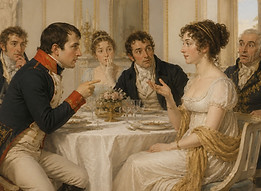
The Duchess Who Stood Up to Napoleon
As a young woman, Laure Permon, who would later marry Jean-Andoche Junot, one of Napoleon's most loyal generals, and become Duchess of Abrantès, moved in circles close to the Bonaparte family. She quickly became known for her wit, intelligence, and remarkable self-confidence. One story from her youth tells how she attended a dinner at which the young Napoleon Bonaparte was present. At a time when most young women would have been intimidated by the future emperor, Laure openly contradicted him during the conversation. When Napoleon attempted to end the discussion with his usual authority, she reportedly continued arguing her point. Those present were astonished. Napoleon himself was said to have been amused rather than offended and later remarked that she possessed an unusually fearless tongue.
Why it is memorable: Most people feared Napoleon. Laure challenged him openly and spoke to him as an equal. The anecdote perfectly captures the confidence, independence, and quick wit that later made the Duchess of Abrantès one of the most remarkable women of Napoleonic society.
Kutepov Ref 61

Kidnapped in Broad Daylight
After the Russian Revolution and the victory of the Bolsheviks, General Alexander Kutepov became one of the leading figures of the White Russian émigré community in Paris. Unlike many exiles who gradually accepted that the old Russia was gone, Kutepov remained committed to the struggle against the Soviet regime. He organized anti-Soviet networks, maintained contacts with resistance groups inside the USSR, and became one of the most determined opponents of the Soviet government abroad. This made him a target. On the morning of 26 January 1930, Kutepov left his residence in Paris and was walking near the Arc de Triomphe when he was approached by men posing as French police officers. Witnesses later reported a brief struggle before he was forced into a waiting car. The kidnappers were agents of the Soviet secret police. For decades, uncertainty surrounded his fate. Some accounts claimed he died of a heart attack during the abduction. Others suggested he was being transported toward the Soviet Union when he died. The exact circumstances remain disputed. The disappearance shocked the Russian émigré world. One of the most prominent White generals had vanished from the streets of Paris itself.
Why it is memorable: This was not a medieval legend or a wartime battlefield death. It was a political kidnapping carried out in one of Europe's great capitals. The affair demonstrated that even years after the Russian Civil War, the conflict between the Soviet state and its exiled opponents continued far beyond Russia's borders.
Le Normant Ref 363

The King Took His Wife... He Took the King’s Mistress
Charles-Guillaume Le Normant d’Étiolles married Jeanne-Antoinette Poisson in 1741 and was reportedly deeply attached to her. But only a few years later, his wife caught the attention of King Louis XV. In 1745, she became the king’s official mistress and entered history as the celebrated Madame de Pompadour. Le Normant was forced to accept a separation from the woman who had effectively left him for the most powerful man in France. There is, however, an ironic sequel. Charles-Guillaume later formed a lasting relationship with Marie-Anne Matha, a dancer who had herself been among Louis XV’s mistresses. She bore him children, and after Madame de Pompadour’s death in 1764, Charles-Guillaume eventually married her. Thus, in one of those curious reversal’s characteristic of eighteenth-century court society, the king had taken Le Normant’s wife, while Le Normant later made his life with a mistress of the king.
Why it is memorable: Few marital stories capture the peculiar world of Louis XV’s France quite so neatly: Charles-Guillaume Le Normant lost his wife to the king, only to later share his life with a woman who had previously been the king’s mistress.
Mailly-Nesle (de) Ref 331

Four of them Had Affairs with King Louis XV
Few noble families can claim a story as extraordinary as that of the Mailly-Nesle sisters. During the reign of Louis XV, four of the five daughters of the Marquis and Marquise de Nesle became associated - successively and sometimes controversially - with the king's affections. The first was Louise Julie de Mailly-Nesle, who became Louis XV's mistress in 1738. Gentle and discreet, she seemed an unlikely figure to dominate court gossip. Yet her position opened the doors of Versailles to her sisters. Soon, Pauline Félicité attracted the king's attention and supplanted Louise Julie in his affections. After Pauline's death in childbirth, another sister, Marie Anne de Mailly-Nesle, emerged as the most ambitious of them all. Intelligent, determined, and politically minded, she became one of the king's most influential companions and encouraged him to seek military glory during the War of the Austrian Succession. Meanwhile, Diane Adélaïde was also associated by contemporaries with the king, though historians continue to debate the exact nature of their relationship. Only Hortense Félicité escaped the remarkable pattern and never became Louis XV's mistress. The spectacle fascinated and scandalized Europe. Courtiers joked that Versailles had become almost a family affair for the Mailly-Nesles.
Why it is memorable: Royal mistresses were hardly unusual at the French court. What made the Mailly-Nesle family unique was that four sisters became linked, in one way or another, to the same king. Even by the standards of eighteenth-century Versailles, it was a story sensational enough to fuel gossip across Europe.
Maria II of Portugal (Queen) Ref 289

A True Love Story
Many royal marriages of the nineteenth century were arranged for political reasons and never developed into close personal relationships. The marriage of Queen Maria II of Portugal and King Ferdinand II appears to have been one of the exceptions. Although their union was arranged in the usual dynastic manner, the couple quickly formed a deep attachment. Maria spoke warmly of Prince Ferdinand of Saxe-Coburg and Gotha even before their first meeting, and over the next seventeen years they developed a partnership based on affection, trust, and mutual respect. They exchanged loving letters when apart, relied on one another's advice, and devoted much of their time to their growing family. Their happiness was cut short in 1853 when Maria died during the birth of her eleventh child at the age of thirty-four. Contemporary accounts describe Ferdinand standing beside her bed in tears, devastated by the loss. Years later, he still wrote of the profound emptiness her death had left behind.
Why it is memorable: At a time when royal marriages were often little more than political contracts, the marriage of Maria II and Ferdinand II appears to have been a genuine love match. Ferdinand's lifelong grief after her death turned their story into one of the most touching royal romances of nineteenth-century Europe.
Mathieu de Vienne Ref 330

Piano Lessons Saved His Life
In 1812, Jean-Baptiste Mathieu de Vienne entered Russia with Napoleon's Grande Armée. After surviving the terrible retreat from Moscow and crossing the Berezina, he was captured by the Cossacks and thrown into a harsh captivity. The odds of survival were dreadful. According to his memoirs, only two of approximately three hundred prisoners in his group survived the ordeal. Jean-Baptiste might easily have shared the fate of the others had an unexpected opportunity not arisen. A Russian general was searching for someone capable of teaching piano to his daughters. Jean-Baptiste, who had received the education expected of a cultivated young gentleman, possessed precisely the skills required. Instead of remaining among the ordinary prisoners, he was employed as a music teacher. The appointment quite literally saved his life. After his release, he still spent many months disguised as a Polish peasant before finally returning to France in 1814.
Why it is memorable: Thousands of French officers and officials perished during the retreat from Russia. Jean-Baptiste Mathieu de Vienne survived not because of his military abilities, but because he could play the piano. In one of the most disastrous campaigns in European history, a gentleman's musical education proved more valuable than a sword. Napoleon's campaign could not save him, but a piano lesson could.
Monge Ref 37

The Teenager Who Solved the Impossible Fortification Problem
Gaspard Monge was born in 1746 in Beaune, the son of a modest merchant. As a young man, he attended a military school at Mézières, but because he was not of noble birth, he was employed merely as a draftsman rather than as an officer or engineer. One day, the school's military instructors faced a difficult problem: how to design the defensive works of a fortress so that every approach could be covered by artillery fire. Solving such problems normally required lengthy calculations and was the domain of senior engineers. The teenage Monge quietly devised a completely new graphical method. Instead of relying on traditional calculations, he used geometric projections to represent the terrain and fortifications. The solution was elegant, rapid, and astonishingly effective. When the officers saw his work, they were reportedly so impressed that they abandoned their initial reluctance and promoted him into the engineering corps despite his humble origins. The method he developed would later evolve into descriptive geometry, a discipline that became fundamental to engineering, architecture, military science, and eventually modern technical drawing.
Why it is memorable: The story has a classic "genius discovered" quality. A young man excluded from advancement because of his social status solved a problem that senior specialists struggled with. His talent was so undeniable that the established hierarchy had to make an exception.
Muiron Ref 332

Napoleon Named a Frigate After His Saviour
Few military tributes were as personal as Napoleon's decision to rename a captured Venetian frigate La Muiron. The ship honoured Colonel Jean-Baptiste Muiron, the devoted aide-de-camp who was killed while shielding Bonaparte from Austrian fire at the Battle of Arcole in 1796. Two years later, Napoleon secretly embarked aboard the frigate during his daring escape from Egypt. Evading Admiral Nelson's patrols, La Muiron carried him safely back to France, where within weeks he seized power in the Coup of 18 Brumaire and began the political career that would reshape Europe. Napoleon never forgot either the ship or the man whose name she bore. He ordered La Muiron to be preserved as a national monument, commissioned a magnificent model for his study at Malmaison, and even remembered the Muiron family in his will at Saint Helena.
Why it is memorable: Few noble families can claim that their name was given to the very ship that carried Napoleon back to France, enabling the rise of the First Empire and forever linking their legacy to one of history's most consequential voyages.
O'Mahony Ref 13
The O'Mahony Chiefs Became Exiles
The O'Mahonys were once among the principal Gaelic ruling families of southwest Munster, controlling territories along the coast of County Cork and holding strongholds such as Dunlough Castle. Their ancestors had been kings and princes of Desmond, tracing their lineage to the early rulers of Munster. Following the Tudor conquest of Ireland and the collapse of the old Gaelic order, many Irish noble families saw their lands confiscated. The O'Mahonys were among those who gradually lost much of their ancestral power. Rather than disappear, members of the family joined the great Irish military diaspora later known as the Wild Geese, seeking careers in Catholic Europe. What makes the story remarkable is that, although they lost their homeland, the family reinvented itself abroad. O'Mahonys entered the service of foreign monarchs, settled in France and Italy, married into established noble families, and eventually became integrated into continental aristocratic society. Generations later, descendants could be found bearing Irish names while living as respected members of French and Italian noble circles. In a sense, the family accomplished something unusual: they lost a kingdom but preserved their identity. Centuries after their exile, the name Ó Mathghamhna ("descendant of the bear") was still being carried by families who remembered their origins on the coast of Cork.
Why it is memorable: Many noble families vanished after losing their lands. The O'Mahonys instead transformed exile into survival, carrying an ancient Gaelic lineage from medieval Ireland into the salons and noble houses of continental Europe.
Ornano (d') Ref 305

An Assassination That Shocked Corsica
The story revolves around Sampiero Corso (1498–1567), the celebrated Corsican soldier, and his wife Vannina d'Ornano, who belonged to one of the island's most prominent noble families. By the 1560s, Corsica was engulfed in conflict. Sampiero had spent years fighting. His struggle made him a hero to some Corsicans and a dangerous rebel to others. During one of his absences, Vannina found herself in an increasingly precarious situation. The war was devastating the island. According to contemporary accounts, she decided to leave Corsica with her children and seek refuge in Genoese territory. To Sampiero, this was not merely a personal decision. He interpreted it as a betrayal of both his cause and his honor. When he learned of her departure, he ordered trusted followers to intercept her. Vannina was captured and brought before her husband. Despite her noble birth and family connections, Sampiero refused to relent. In 1563, she was executed on his orders. The event caused outrage throughout Corsica. Even among supporters of Sampiero's struggle against Genoa, many considered the act excessively harsh. The tragedy became one of the most discussed episodes in Corsican history.
Why it is memorable: Unlike many noble anecdotes that involve battles or political intrigue, this story is deeply personal. It is a collision between family loyalty and political conviction. Was Vannina a traitor abandoning her husband's cause, or a mother trying to protect her children from a hopeless war? Historians have debated the question for centuries.
Otis Ref 365

The New York He Never Saw
Elisha Graves Otis was not born into the world of great engineers or industrialists. A farmer’s son from Vermont, he worked at various times as a mechanic, wagon maker and factory employee, developing a reputation for finding practical solutions to mechanical problems. In 1853, while working at a factory in Yonkers, New York, he devised the revolutionary safety mechanism that would make elevators far less dangerous. At the time, New York was still a city of relatively modest buildings, and few could have imagined the extraordinary vertical metropolis that would eventually rise above Manhattan. Otis’s invention would help remove one of the greatest obstacles to building ever higher: how to move people safely between floors. Yet fate intervened. Otis died of diphtheria in 1861, aged just forty-nine, before New York’s skyline began its spectacular ascent. He never saw the great skyscrapers, crowded elevator shafts or vertical city his invention helped make possible. The man who helped New York rise never lived long enough to see how high it would go.
Why it is memorable: Elisha Otis reassured the public that his elevators were "All safe, gentlemen, all safe!" Yet death claimed the inventor long before he could see the New York skyline his invention helped build.


Gerry's Collection of Antique Seal Stamps.