


The Silver Collection
Wax sealing stamps in metal and silver, including rare examples dating to the 17th century

Page 1 Page 2
Ref 145 - ♥♥♥♥♥
This seal stamp belonged to Arthur Marie de Kermerc’hou de Kerautem and his wife Marie Caroline Emmanuelle de Saisy de Kerampuil. The de Kermerc’hou family was established in the dioceses of Tréguier, in Brittany. In 1669, the family proved its ancient noble lineage before the Chambre de Réformation, tracing its ancestry back to Philippe de Kermerc’hou, active at the musters of 1479–1480. The de Saisy de Kerampuil family originated in the Nivernais and settled in Brittany in the 14th century. Known as Kerampuil from the 15th century, they were maintained noble in 1669 and again recognized as noble of ancient chivalric extraction in 1778. Admitted to the honors of the Court in 1789, they bore the motto “Qui est Saisy est fort". A point of interest lies in the variable presence of the axe (hache) in representations of the Saisy arms. Some depictions show only the sword and wasp, omitting the axe entirely.


Stained-glass at the St Samson church

The arms of the de Saisy de Kerampuil family, depicting the axe

Comte Paul de Saisy de Kerampuil
Ref 146 - ♥♥♥♥♥
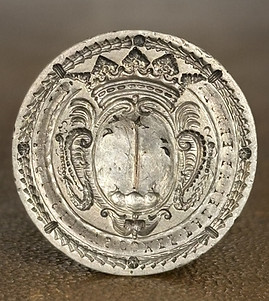
This seal was likely used in Italy during the late Baroque period, probably 1650-1750, and belonged to someone of noble status, perhaps duchess, noble lady, or abbess (due to the oval shield). The coat of arms shows a single vertical charge, possibly a sword or long arrow, rising from a mount or clouds. Stars or crosslets may also be present, though the engraving has become so worn that it is really difficult to identify. The outer border bears inscription, but equally difficult to read.

Ref 147 - ♥♥♥♥♥
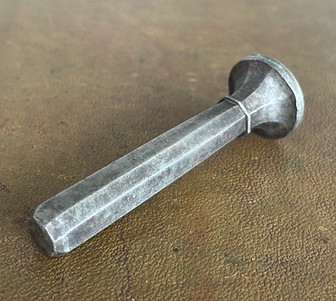
This seal can be attributed to a member of the Reinhart zu Thurnfels und Ferklehen family. We can notice, however, that the flow of the river in the engraved arms runs in the opposite direction to that shown in some printed representations. Such variations are not uncommon in seals and later reproductions. More decisive is the crest, which depicts a lion between two wings, a distinctive and consistent element of the Reinhart zu Thurnfels und Ferklehen arms. This feature strongly supports the identification. The family belonged to the Austrian baronial (Freiherr) nobility and was primarily associated with civil and administrative service rather than military or court life. Its most notable member was Ignaz Freiherr Reinhart zu Thurnfels und Ferklehen (1782–1843), born in Innsbruck and later active in Vienna. Trained in law, he entered the Imperial House Archives in 1806 and rose through the ranks to become Director of the Imperial House, Court and State Archives.


Ref 148 - ♥♥♥♥♥
This silver wax seal stamp belonged to the Zollner von Massenbergs, a Styrian noble family whose name is directly linked to Massenburg, a hilltop fortress above Leoben in Austria. Originally, Zollner (or Zöllner) was an occupational surname meaning customs officer, but by the early 16th century the family had entered the ranks of the territorial nobility. In 1528, Veit Zollner von Massenberg received Massenburg as a hereditary fief in recognition of his services during the Peasants’ War of 1525. From that point, the territorial predicate “von Massenberg” became firmly attached to the family name, marking their integration into the Styrian knightly elite. The castle itself had earlier passed through several noble holders before coming into Zollner possession. As hereditary lords of Massenburg, the family formed part of the Habsburg feudal structure in Inner Austria. They belonged to the lower nobility, landowners and active in service, rather than to the high aristocracy.


Ref 317 - ♥♥♥♥♥
This very old metal seal is engraved with the arms of the Bodart family, a regional noble house of the Meuse and Namur - Liège, which appears to be extinct in the male line. The Bodart family was a lineage of the former Prince-Bishopric of Liège and the region of Namur, later also connected with Belgian Luxembourg and Huy - Tihange. Archives show records of two recognitions of nobility. In 1787: attestation of nobility by the penultimate King of Arms of the Principality of Liège, and in 1861: formal recognition of nobility for Auguste-Florent-Alphonse Bodart. Their arms can be described as: Per pale: 1st, per fess: a) gules, two dolphins haurient addorsed argent; b) azure, five bendlets or; 2nd, argent, three roses gules, seeded or and barbed vert. Crest: two dolphins haurient addorsed argent. An old version of these arms shows "smiling dolphins", which is unusual and charming. Medieval and early modern heraldry sometimes gave animals expressive or even humorous faces, especially in manuscript armorials. It reflects artistic style more than irony, but it certainly gives the arms personality. Among the members of the family, Auguste-Florent-Alphonse Bodart was mayor of Tihange, and Hubert Bodart, Ecuyer, was Premier Échevin (First Alderman) of the city and the County of Rochefort.


Ref 323 - ♥♥♥♥♥
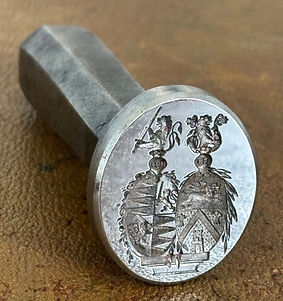
The nice and deeply engraved arms shown on this seal represent the alliance between Josef Anton von Zallinger zum Thurn (1771 - 1825) and Maria Franziska von Egger zu Marienfried (or Marienfrid) (1779 - 1807). It is Bernard Zallinger (1605 - 1677) who founded the Zallinger von (or zum) Thurn lineage, after the Thurn estate, which they acquired in 1637. The arms of the Zallinger von Thurn branch differ from the original Zallinger arms by replacing one of the three fleurs-de-lys with a tower. The Zallinger von Thurn family was an old Austrian noble house originating from the mercantile elite of Bozen (Bolzano) in South Tyrol. Originally from Augsburg and Füssen, the family settled in Bozen in the late 16th century and rose through commerce, municipal office, and imperial service. Over time, it produced scholars, magistrates, consuls, churchmen, and notable intellectuals, becoming part of the educated aristocracy of the Habsburg world. The Egger von Marienfried family belonged to the Tyrolean administrative nobility associated with Innsbruck and Kufstein. Entered into the Tyrolean noble register in the early 18th century, the family rose through legal and governmental service. Members such as Josef Anton Egger von Marienfried held important judicial and administrative functions within the Habsburg monarchy. Together, both families illustrate the rise of a cultivated regional nobility rooted in service, education, and public administration rather than ancient feudal power.




Maria Franziska von Egger zu Marienfried
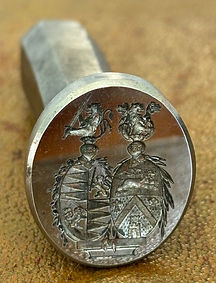
Seal engraved with both families' arms

Funeral card for Joseph von Zallinger zum Thurn
Ref 329 - ♥♥♥♥♥
Without certainty, this seal could possibly have belonged to the Matraini or the Casotti families. While the seal was bought from Nice, in France, research shows that both families appear to have had branches or descendants who moved beyond Italy, including into France. The Matraini family originated from Lucca, a Tuscan republic whose merchant families were highly international. From the 16th to the 18th centuries, many Lucchese commercial families established themselves abroad. It would not be surprising that individual members of the Matraini family settled in cities such as Lyon or Marseille, where many Italian merchant families became established. The best-known member of the family was Chiara Matraini (1515 - 1604), one of the most important female writers of the Italian Renaissance. The Casotti were also associated with Lucca and northern Italy, and some members did settle in France. There are traces of the name Casotti de la Rive and de Casotti, suggesting integration into francophone bourgeois or noble society. Some branches are also recorded in Croatia and Slovenia. Augustin Kažotić (Agostino Casotti) was the most important member of the old noble Kažotić - or Italianized Casotti - family of Trogir in Dalmatia. Born around 1260, he entered the Dominican Order and later studied theology in Paris, becoming one of the most learned churchmen of his time. Another member of the family was Giovambattista Casotti (1669 - 1736), an Italian priest belonging to the noble Casotti family branch of Bolognese origin later established in Tuscany. Educated in the humanist tradition, he became an important intellectual figure in Florence and Prato during the late 17th and early 18th centuries. He served as rector of the Academy of Nobles, and member of the prestigious Accademia della Crusca. Archives show that he was a count (Conte in Italian), which matches with the coronet engraved on the seal. Giovambattista Casotti thus belonged to a comital branch of the Casotti family, and we could speculate that the seal belonged to a descendant of that family branch, which was probably one integrated into the Tuscan or Bolognese nobility.


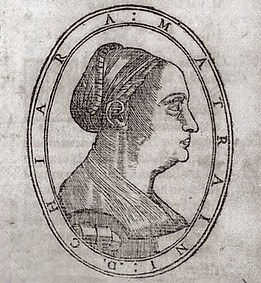


Giovani Battista Casotti

Details of the seal made of silver

Agostino Casotti (Augustin Kažotić)
Ref 330 - ♥♥♥♥♥
It has not yet been possible to identify the arms of the husband in the alliance coat of arms this seal. However, the arms of the wife are those of the Mathieu de Vienne family, which was a distinguished French family of the noblesse de robe, originating in Sainte-Menehould in Champagne and established at Vienne-la-Ville in the Argonne. The family was ennobled on 12 December 1815 when Jean-Baptiste Mathieu de Ville (1765 - 1837), former trésorier de France at Châlons and later examining magistrate at Sainte-Menehould, received letters of nobility during the Bourbon Restoration. Several members combined public service with intellectual pursuits. Among them, Jean-Baptiste Mathieu de Vienne survived the disastrous retreat from Moscow in 1812, Russian captivity, and a remarkable return to France, leaving a valuable memoir of his experiences. His descendant, Colonel Maurice Mathieu de Vienne (1846–1907), was an artillery officer, veteran of the Franco-Prussian War, officer of the Legion of Honour, numismatist, historian, and member of numerous learned societies.


Ref 343 - ♥♥♥♥♥
This metal seal is engraved with the arms of the Zboiński (also written Zboinski) family, a lineage belonging to the Polish–Lithuanian nobility (szlachta), with origins in Mazovia and neighboring regions. Members of the family are recorded from at least the 16th - 17th centuries. Ignacy Antoni Zboiński (born 1715) pursued a notable political career. He successively held offices in the Dobrzyń region, becoming castellan of Płock in 1756 and later voivode of Płock in 1791, a senatorial dignity within the Commonwealth. Other members of the family include Franciszek Ksawery Zboiński, who also attained the voivodeship of Płock, and Xawery Zboiński, whose name appears in the form “Xawery z Podoskich Zboińskiej.” This reflects Polish naming conventions and designates a member of the Zboiński family connected to the Podoski lineage, either by birth or marriage.


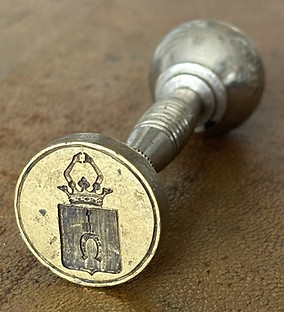


Ref 353 - ♥♥♥♥♥
This seal is engraved with the arms of the Riedl family, a burgher family recorded in the armorials of Chur, in present-day Switzerland. Located at the crossroads of the Alpine passes linking southern Germany, Graubünden, and northern Italy, Chur was a commercial center, and its leading families played active roles in trade, municipal government, and the administration of customs. The Riedl family formed part of this influential urban elite. We notice the heavily worn striking surface at the top of the handle. Rather than indicating damage, this flattened and mushroomed appearance was most likely produced by repeated hammer blows over many years of practical use. Metal seals were commonly placed on hardened sealing wax and lightly struck with a small hammer or wooden mallet to produce crisp impressions on legal, administrative, and commercial documents. It is also possible that the seal occasionally served as a stamp for marking leather, lead seals, or other goods associated with trade. Whatever its precise use, the wear suggests that it was a well-used working instrument rather than a purely ceremonial object.


Ref 356 - ♥♥♥♥♥
This seal bears the arms of the Varnod -or Warnod - family, an ancient bourgeois family of Neuchâtel, Switzerland, documented since the fourteenth century. Unlike noble houses, the Varnods belonged to the influential patrician class, whose members played an important role in the commercial and civic life of the principality. Their history took an unusual turn in 1494, when Nicolet Varnod, the last representative of the original line, adopted his nephew Jaquet Perregaux, who assumed the Varnod surname and became the founder of the later family. The family's distinctive coat of arms features a golden compass on a blue field, a symbol traditionally associated with precision, knowledge, and craftsmanship. Some heraldic variants also include stars or a triple mount. Although never ennobled, the Varnods remained a respected Neuchâtel family for centuries, and one branch later established itself in France, preserving both the name and its heraldic tradition.


Ref 358 - ♥♥♥♥♥
The coat of arms engraved on this seal represent the Pomeranian branch of the Schack (or von Schack) family. The family belongs to the ancient Uradel of northern Germany, with documented origins dating back to the twelfth century in the Duchy of Lüneburg. Over the following centuries, different branches spread into Holstein, Mecklenburg, Pomerania, and Denmark. Danish branches were elevated to the rank of Count (Greve), becoming one of the leading noble houses of the Danish monarchy. The family arms are remarkably consistent across the various branches. The shield displays Gules, a fleur-de-lis Argent, a simple but distinctive design that has remained the hereditary emblem of the family since the Middle Ages. While the shield remained unchanged, the crest evolved differently in separate branches. The original Lüneburg and Holstein branches, represented in many German armorials, bear as their crest a silver fleur-de-lis placed between two buffalo horns. In contrast, the Pomeranian branch adopted a far more elaborate crest consisting of a young maiden, crowned with a wreath, holding a silver fleur-de-lis in each hand. The seal itself, which appears to date from the late nineteenth century, represents Kaiser Wilhelm I, who was the German Emperor from 1871 to 1888. The heraldry identifies the family branch, while the handle celebrates allegiance to the reigning monarch.


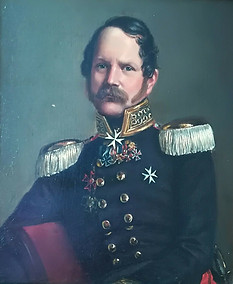
Wilhelm von Schack
Arms of the Pomeranian branch of the Schack family
August von Schack


Ref 363 - ♥♥♥♥♥
This seal can plausibly be attributed to the Le Normant family of Orléanais, although the precise branch and original owner remain unidentified. The strongest evidence is the heraldry: the shield displays four rocs d’échiquier arranged quarterly, together with a small central escutcheon charged with a fleur-de-lis. This combination is well documented for branches of the Le Normant family and closely corresponds to historical representations of their arms. The family was an old and extensive house, known from around 1300 and said in one nineteenth-century account to have formed twenty-seven branches! This considerable multiplication of branches helps explain why variations of the arms are encountered. Some sources show the shield quartered Gules and Argent, others Gules and Or, while certain versions include the central fleur-de-lis and others omit it. According to the same historical account, the fleur-de-lis was granted by King Charles VII to Renaudin Le Normant, écuyer, seigneur du Mesnil and governor of the town and château of Mehun-sur-Yèvre. The seal forms part of a luxury desk object manufactured by Barbedienne, whose handle reproduces an antique-style bust of a bearded philosopher. The object itself was therefore commercially produced, while the armorial matrix was individually engraved for its owner. Taken together, the four chess rooks, central fleur-de-lis, coronet and supporters make an attribution to a branch of the Le Normant family convincing, while leaving the exact branch unresolved.


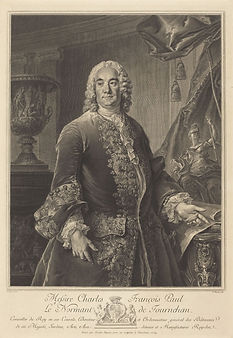
Charles-Guillaume Le Normant d'Étiolles
Arms of the Le Normant family
Charles Francois Le Normant de Tournehem


Ref 365 - ♥♥♥♥♥
This seal is engraved with the arms of the Otis family, one of the oldest and most distinguished colonial families of New England. The family traces its origins to John Otis (1581 - 1657) of Glastonbury, Somerset, England, who emigrated to Massachusetts in 1635. Although the Otises were never members of the titled nobility, they belonged to the English armigerous gentry and bore the arms: Argent, a saltire engrailed between four cross-crosslets fitchée azure, with the crest of an embowed arm holding a laurel branch and the motto Sapiens qui vigilat (“Wise is he who keeps watch”). Over the following centuries, the family produced many influential figures in American history. James Otis Jr. became one of the earliest advocates of colonial rights and helped lay the intellectual foundations of the American Revolution. His sister, Mercy Otis Warren, was an accomplished historian, playwright and political writer, while Samuel Allyne Otis served as the first Secretary of the United States Senate. Harrison Gray Otis became a United States Senator and Mayor of Boston, reinforcing the family's place among the leading Boston Brahmin families. Among the many distinguished descendants of the Otis family, Elisha Graves Otis (1811–1861) became one of the most influential inventors of the nineteenth century. Although he did not invent the elevator itself, he transformed its future by developing the safety elevator brake in 1853. His ingenious mechanism automatically locked the elevator platform onto guide rails if the hoisting rope failed, eliminating the greatest danger associated with early lifts. Elisha founded the Otis Elevator Company, which rapidly became the world's leading manufacturer of elevators.


James Otis Sr
Arms of the Otis family
Elisha Otis


Page 1 Page 2
Gerry's Collection of Antique Seal Stamps.