


The Wooden Collection
Antique sealing stamps crafted from precious woods, including ebony, walnut, and rosewood

Ref 302 - ♥♥♥♥♥
This antique seal is engraved with canting arms that could have been those of Maurice Bicher, écuyer, conseiller du Roi and trésorier under the Ancien Régime. In heraldry, canting arms (armoiries parlantes) visually allude to the bearer’s name through a symbolic pun. In this case, the shield shows a hind (biche), which directly echoes the surname Bicher, making the arms “speak” the family name. Maurice Bicher belonged to the administration of the French monarchy. The title écuyer indicated noble standing in the lesser nobility. As conseiller du Roi, he served within the royal administration, while his office as trésorier placed him within the financial system responsible for managing royal revenues and payments. Such offices were commonly associated with the noblesse de robe, whose members held judicial and financial posts and could, over time, transmit noble status to their descendants.


Ref 303 - ♥♥♥♥♥
This seal presents the arms of the de Courtarvel family, blazoned: D’azur au sautoir d’or accompagné de seize losanges du même, posés quatre en croix et douze en orle. The family held the titles marquis de Pezé, de Saint-Rémy et de Courtarvel and possessed numerous seigneuries, including La Lucazière, Saint-Germain, Baillou, Valennes, Boursay, Trémigon, Verdes, Boisgency, Monterestin and Lierville. The seal may have belonged to Claude or Jules or de Courtarvel, born in 1761 and 1768. Behind the shield appears an eight-pointed cross, identifiable as the cross of the Order of Saint-John of Jerusalem, later known as the Order of Malta. This indicates that the owner of the seal was a Knight of Malta, a distinction reserved for men of proven nobility. Members of the Courtarvel family are indeed recorded among the knights of the order during the 17th and 18th centuries, including André de Courtarvel in 1618 and several sons of René-César de Courtarvel. The chief bearing a cross also refers to the same institution, as in many armorial representations of Hospitaller knights a cross is added to the shield itself in addition to the large cross placed behind it. The decoration placed beneath the shield appears to represent the badge of the Ordre royal et militaire de Saint-Louis, whose knights wore a cross suspended from a ribbon. This distinction was notably awarded to Claude and Jules de Courtarvel, which strengthens the possibility that this seal may have belonged to one of them.


The seal displays the arms of the de Courtarvel family, accompanied in chief by the cross of the Knights of Malta, with an eight-pointed cross set behind the shield.
Ref 308 - ♥♥♥♥♥
This wooden seal is possibly related to the Santa Maria family, from Calalonia, in Spain. The family appears to have been an old armigerous lineage of the Segarra region, documented from at least the early fourteenth century. References to individuals in Cervera and Solsona, together with the account of a knight serving King James II of Aragon in 1309, place the family within the milieu of the Catalan cavallers, that is, the lesser nobility. Their coat of arms, featuring an azure field with wavy silver bars and three stars in chief, is consistent with medieval Iberian heraldic practice and suggests a recognized, though not elevated, social standing. Like many Catalan surnames, “Santa Maria” is toponymic and was adopted independently by several unrelated families, typically deriving from a local church, estate, or settlement bearing that name. Consequently, the lineage in question should be understood as one among several distinct families, possessing noble status without evidence of a hereditary title.


Ref 309 - ♥♥♥♥♥
This seal belonged to the Italian Suardi family, also written Suardo and occasionally Soardo in older forms. They were one of the oldest and most important noble families of Bergamo, with origins that can be traced to Pietro, called Suardo, in the 11th century, and from whom numerous branches developed over time. They played a major role in communal politics, producing consuls, podestà, captains, bishops, diplomats, and later senators and public officials. The family divided into many branches, including the Ruggeri, Regolati, Testa, Secco-Suardo, the Suardi counts of Trescore, the Suardo counts, and the Suardi of Ranzanico. This branching explains why the name appears in several forms and why titles, residences, and heraldic details are not always identical from one line to another. The family possessed numerous residences and estates in Bergamo and its territory, including palaces in the city and properties at Trescore.


.jpg)
Count Galeozzo Secco Suardo

Arms of the Suardi family
.jpg)
Countess Secco Suardo
Ref 313 - ♥♥♥♥♥
This antique seal bears the arms of the Brentano (or Brentani) family, an old lineage originating from the Lake Como, in Italy. References place the family in this region as early as the late Middle Ages, where it was regarded as a local noble house. Over time, the family divided into several branches, often taking their names from estates or localities. From the 17th century onward, members of the family migrated northward, particularly to Frankfurt am Main, attracted by the opportunities of long-distance trade. There, the Brentanos became a prominent merchant dynasty, dealing in commodities such as wine and colonial goods. This expansion explains the presence of numerous branches in German-speaking regions, as reflected in armorial collections mentioning Frankfurt, Baden, Bavaria, Saxony, and Austria. The designation “von Comersee” recalls their origin from Lake Como. The Brentano family produced notable figures, such as Clemens Brentano and the philosopher Franz Brentano. The multiplication of branches led to variations in their coats of arms.


Clemens Brentano

Ref 314 - ♥♥♥♥♥
This is a seal of the Seuberlich family, a German-Baltic lineage originally from East Prussia, which became established in Riga from the second half of the 18th century. It was not an old noble house, but rather a family of the educated urban elite, including pastors, merchants, municipal officials, writers, and later genealogists. An early figure was Magister Friedrich Seuberlich (1668 - 1729), an Evangelical clergyman at Rastenburg/Kętrzyn, recorded as pastor there from 1703 to 1729. Later, the family’s centre shifted to Riga. Johann George (1736 - 1794) was an innkeeper at the “Golden Anchor” in Riga, while Robert Joachim (1799/1800 - 1856) became mayor of Riga, showing the family’s rise within Baltic German civic society. The best-known member was Erich Seuberlich (1882 - 1946), a German-Baltic genealogist and author of a major genealogical work on Baltic families. The arms, showing a pelican feeding its young, fit well with a learned Protestant family tradition, symbolizing sacrifice, piety, and service.


Ref 316 - ♥♥♥♥♥
Looking at the round shape of the shield and the presence of a coronet of marquis, we could speculate that this seal belonged to Marie Geneviève Rosalie or her sister Marie Bonne Henriette Le Bret. While their father, Cardin Le Bret, was a count, they both married a marquis. The Le Bret family is a French noble lineage originating from Gisors in Normandy, whose rise illustrates the typical trajectory of the noblesse de robe. . Its ennoblement dates to 1578, when members, already established as jurists, secured noble status through high judicial office. In its early generations, the family bore the usual style of écuyer and held various seigneuries, including Flacourt, Nucourt, Pantin, and Selles-sur-Cher. These designations reflected landholding and social rank but did not constitute formal titles. Among its most prominent figures was Cardin Le Bret (1558–1655), a jurist closely associated with Cardinal Richelieu and author of an influential treatise on royal sovereignty, which supported the development of absolute monarchy. His descendants continued this tradition of service. Pierre-Cardin Le Bret (1639–1710) held major administrative posts as an intendant and later became First President of the Parliament of Provence. Another notable figure, Pierre Le Bret de Flacourt, served as a naval officer under Louis XIV. The family reached the height of its social elevation in the 18th century, when a member of the senior branch, Cardin Le Bret de Flacourt (1675–1734), was granted the title of Comte de Selles in 1727. A German branch of the Le Bret family, known as Le Bret von Nucourt, originated after the Revocation of the Edict of Nantes (1685), when Protestants left France. Nicolas Le Bret settled in Württemberg, and the family later established itself in Bavaria.


Johann Friedrich Le Bret von Nucourt

Seal engraved with the arms of the Le Bret family

Marguerite Henriette Le Bret.
Ref 318 - ♥♥♥♥♥
This important and rather large seal is engraved with the arms of the Mancini-Mazarini family. The inscription on its handle make the object even more interesting. While the original lineage was the ancient Roman noble House of Mancini, the celebrated Mancini-Mazarini family branch originated from the marriage of Michele Lorenzo (Michel-Laurent) Mancini and Girolama (Geronima) Mazzarini, sister of the famous Cardinal Mazarin. Following the extraordinary rise of Cardinal Mazarin in France, who succeeded Cardinal Richelieu as first minister of Louis XIII, and then of Louis XIV. the fortunes and identities of the two families became closely intertwined. The compound style Mancini-Mazarini was subsequently adopted by descendants who inherited the titles, wealth, and prestige associated with Mazarin and his heirs. This union proved historically decisive, as the children of Lorenzo Mancini and Geronima Mazzarini - the famous Mazarinettes - entered the highest circles of European aristocracy. Among them were Marie Mancini, the first great love of Louis XIV, Olympia Mancini, mother of Prince Eugene of Savoy, Hortense Mancini, Duchess of Mazarin and later mistress of Charles II of England, and Philippe Mancini, Duke of Nevers, from whom descended the later princely branch generally styled Mancini-Mazarini. Thus, although the alliance between Michele Lorenzo Mancini and Geronima Mazzarini united the two families' identities, it was through their descendants in France that the name Mancini-Mazarini became a firmly established dynastic house.


Arms of the Mancini family

Girolama Mazarini


Philippe Mancini, Duke of Nevers from 1661 to 1707
Arms of the Mazarini family


Mancini-Mazarini inscription on the seal
Louis-Jules Mancini-Mazarini
Ref 319 - ♥♥♥♥♥
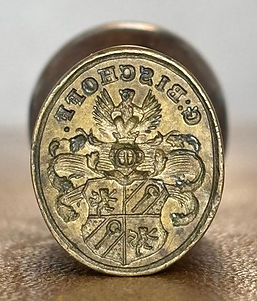
This seal is engraved with the arms of Gottlieb Wilhelm Bischoff (1797–1854), who was a German botanist, university professor, and an important figure in early 19th-century plant science. He was born in Dürkheim, Germany. He became professor of botany in 1833, and from 1839 served as director of the botanical garden of Heidelberg. Bischoff’s scientific work focused mainly on cryptogamic plants, especially mosses and liverworts. He was among the first to study their reproductive structures in a systematic way and is credited with introducing key botanical terms such as archegonium and antheridium, which remain in use today. He also published several important botanical works, including textbooks and reference works that contributed to the development of plant morphology and terminology in the 19th century. His teaching influenced a number of later botanists, and he was elected to the Leopoldina, one of the oldest scientific academies in Europe. Bischoff died in Heidelberg on 11 September 1854. His name is preserved in botany through the plant genus Bischofia, named in his honor.


Ref 322 - ♥♥♥♥♥
This seal is engraved with the arms of the Canneel family, an old Belgian lineage with roots in the medieval cities of Flanders. The earliest known reference dates to 1397, when a certain Jan Caneele, originally from Ghent, was recorded in the burghers’ register of Bruges. By the late fifteenth century, the family had firmly established itself in Bruges, where generations worked as fishmongers. This profession, central to the city’s economy, was passed down from father to son for centuries and is reflected in the family’s coat of arms, which features a fish. The family’s long association with the fish trade continued until the upheavals of the French Revolution, which brought an end to guild privileges and hereditary occupations. After this period, members of the Canneel family diversified into new fields, including, administration, trade, and the military. Over time the family spread beyond Belgium, to Holland and even South Africa.


Théodore-Joseph Canneel

Coat of arms of the Canneel family

Isidore Alexander Canneel
Ref 331 - ♥♥♥♥♥
This is the seal of François de Mailly-Nesle. The House of Mailly was one of the oldest and most distinguished noble families of Picardy, tracing its origins to the medieval lords of Mailly-Maillet. Over the centuries, the family divided into several branches, including Mailly-Nesle, Mailly-Rubempré, and Mailly-Haucourt, whose members served the French Crown as soldiers, churchmen, diplomats, and administrators. Through alliances and inheritances, the family acquired numerous seigneuries and played a prominent role in the political and social life of the kingdom. Among its most distinguished members was François de Mailly (1658–1721). A younger son of the Mailly-Nesle branch, he pursued an ecclesiastical career and rose to become Archbishop of Arles in 1697. In 1710 he was appointed Archbishop-Duke of Reims, one of the highest dignities in the French Church. He was also a Peer of France and was created Cardinal in 1719. His prestige made him one of the most influential churchmen of his generation. The family also produced notable military figures, including Louis III de Mailly-Nesle and the celebrated Marshal Augustin-Joseph de Mailly, Marquis d’Haucourt, who served France with distinction during the eighteenth century. Another branch, the Mailly-Rubempré line, inherited important estates and ensured the continuation of the family’s influence into later generations. The name of Mailly is also remembered through the four sisters of the Mailly-Nesle branch who became favorites of King Louis XV.


Arms of the senior line, Count of Mailly

Henriette de Mailly-Nesle.

Francois de Mailly, Archbishop of Reims

Arms of the Marquis de Mailly-Nesle

Seal of Francois de Mailly

Count Joseph Augustin de Mailly d'Haucourt
Ref 334 - ♥♥♥♥♥
This seal bears a simple but ancient coat of arms: a shield horizontally divided into alternating bands. Although the attribution cannot be certain, the most convincing identification is with the de Brisay family, an old noble house of western France. The arms on the seal indeed correspond closely to those traditionally borne by the Brisay family: fascé d’argent et de gueules de huit pièces. This design, while not unique, is well documented for the House of Brisay and appears in several armorial sources. The coronet above the shield corresponds with the titles of the family, including the marquises of Brisay and the marquises of Denonville. The House of Brisay, formerly written Brizay, took its name from a seigneury in Touraine, near the borders of Poitou. It was a family of ancient chivalric origin, later divided into several branches and associated with lands such as Brisay, La Roche-Brisay, La Mothe, Doussay, Avesnes, Denonville, Beaumont, and Montbazillac. Over the centuries, its members served as military officers, governors, seigneurs, marquises, and counts, representing the traditional provincial nobility of the kingdom. Among the best-known members was Jacques-René de Brisay, Marquis de Denonville. A soldier and royal officer, he was appointed Governor General of New France from 1685 to 1689. Another later representative was Louis-René de Brisay (1767–1839), who belonged to the generation that lived through the Revolution, the Empire, and the Restoration, a period during which many old noble families had to adapt to a transformed France.


Jacques Rene de Brisay

Seal attributed to the de Brisay family

Louis René de Brisay
Ref 336 - ♥♥♥♥♥
This seal commemorates the marriage of The Honorable Martin Sandys (c.1729 - 1768) and Mary Trumbull (1741 - 1769), celebrated at St George's, Hanover Square, London, in 1760. The engraved arms combine those of the Sandys family with a central escutcheon of pretence bearing the arms of Trumbull, indicating that Mary was the heraldic heiress of her family. Martin Sandys was the second son of Samuel Sandys, 1st Baron Sandys of Ombersley, one of the leading Whig politicians of his generation. Samuel served as Chancellor of the Exchequer, Leader of the House of Commons, and was elevated to the peerage in 1743. Martin himself pursued a distinguished military career, attaining the rank of Colonel and serving as Equerry to Prince William Augustus, Duke of Cumberland, one of the most senior positions in the royal household. Mary Trumbull was the only child and heiress of William Trumbull of Easthampstead Park, Berkshire, whose family had long enjoyed prominence in royal and diplomatic service. Her grandfather, Sir William Trumbull (1639 - 1716), served as ambassador to France and Constantinople, later becoming Secretary of State under William III. Easthampstead Park had been in Trumbull ownership since the reign of Charles I and remained one of the family's principal seats. Although Martin and Mary both died comparatively young, their descendants inherited the combined Sandys and Trumbull estates and arms. Their daughter Mary Sandys later became Baroness Sandys in her own right and married Arthur Hill, 2nd Marquess of Downshire, ensuring that both the Sandys title and the Trumbull inheritance continued through one of Britain's leading aristocratic houses.


Sir William Trumbull

Inscription attributing the seal to Marin and Mary

Samuel Sandys, 1st Baron Sandys
The Escutcheon of Pretence in British Heraldry
One of the most distinctive features of British heraldry is the escutcheon of pretence, a heraldic device used when a man marries a heraldic heiress. Unlike continental heraldic traditions, where the arms of husband and wife were commonly shown side by side or impaled on a divided shield, English heraldry developed a unique method of expressing hereditary claims through marriage. A heraldic heiress is not simply a daughter. She is a daughter who has no surviving brothers, or whose brothers leave no descendants, and therefore becomes the person through whom her father's coat of arms will pass to future generations. Because she represents the continuation of her paternal line, her arms occupy a special place in her husband's heraldry. This principle is beautifully illustrated by the present seal, engraved for the marriage of The Honourable Martin Sandys and Mary Trumbull. Martin's shield displays the quartered arms of the Sandys family, but at its centre appears a smaller shield bearing the arms of Trumbull. This smaller shield is the escutcheon of pretence. The word pretence should not be understood in its modern sense of "pretending." It derives from the older legal meaning of a claim or pretension. By placing his wife's arms upon a central escutcheon, Martin Sandys proclaimed that, through his marriage to Mary Trumbull, he had acquired a legitimate claim to represent the Trumbull inheritance. The arms did not become his own by birth; rather, he held them in right of his wife, who was the heraldic representative of her family.

Ref 339 - ♥♥♥♥♥
The engraving on this seal depicts a marriage between two members of the Polish Szlachta (nobility). Rather than displaying the arms of two individual families, it bears the arms of two distinct heraldic clans, an important feature of Polish heraldry: The Lada clan and the Prus clan, each depicted with its own crest. Unlike the heraldic traditions of England, France, or Germany, where a coat of arms usually belonged to a single family, the Polish system was based on heraldic clans (rody herbowe). Both coats of arms have medieval origins. The Łada arms are recorded in documents as early as the beginning of the fifteenth century and were described by the chronicler Jan Długosz in his famous armorial. The Prus arms are equally ancient and exist in several recognized variants, of which Prus II is engraved on this seal. Over the centuries, numerous distinguished Polish families belonged to these heraldic clans. Although the identity of the couple remains unknown, the seal is an illustration of the distinctive character of Polish heraldry.


Ref 344 - ♥♥♥♥♥
This seal can most plausibly be attributed to the Ortner family, whose arms are recorded in Siebmacher's Grosses und Allgemeines Wappenbuch among the German burgher families. The engraving corresponds to the published arms. Both display a shield divided per fess with a sea-horse issuing from the line of partition, surmounted by a crest showing the upper half of the same creature between two buffalo horns. The only apparent difference lies in the representation of the tinctures. The archival drawing is a simple line illustration and therefore does not indicate the heraldic colors, whereas the engraver of the seal used the traditional system of heraldic hatching to distinguish the metals argent and or. The composition of the arms is otherwise identical, making the attribution highly convincing. The Ortner family appears to have originated from southern Germany or Austria, where numerous prosperous merchant and civic families were granted hereditary coats of arms from the sixteenth century onwards.


Ref 349 - ♥♥♥♥♥
This is a seal of the de La Tour du Pin family, a noble house of the French Dauphiné. Their history goes back to the Middle Ages, and the family traced its ancestry to the ancient Dauphins of Viennois, from whom several cadet branches descended. These branches acquired numerous lordships and marquisates, including Gouvernet, La Charce, Montauban, Lachau, Paulin, Rochechalais, and Vissec, becoming one of the leading aristocratic families of southeastern France. The branch known as La Tour du Pin-Gouvernet originated through the marriage of Pierre II de La Tour to Madeleine de Silve, Dame de Gouvernet, around 1510. Through this alliance the family acquired the lordship of Gouvernet, which became the name of one of its principal branches. The family produced numerous distinguished soldiers, diplomats, bishops, and statesmen. Among the best known was Jean-Frédéric de La Tour du Pin-Gouvernet (1727–1794), Lieutenant General, Minister of War under Louis XVI, deputy to the Estates-General, and later a victim of the French Revolution, being guillotined during the Terror. One of the family's most celebrated members was Henriette-Lucy Dillon, Marquise de La Tour du Pin-Gouvernet (1770–1853). Born into the distinguished Irish Jacobite Dillon family, she married Frédéric-Séraphin in 1787 and became lady-in-waiting to Queen Marie Antoinette. Heraldically, the family possessed several related coats of arms reflecting the different branches that emerged over the centuries.


Jean-Frédéric de la Tour du Pin-Gouvernet
Arms of Dame Judith de La Tour de Gouvernet
René de La Tour du Pin-Gouvernet


Ref 352 - ♥♥♥♥♥
This seal bears the arms of the Last Dukes of Burgundy, the Valois princes who ruled the Duchy of Burgundy between 1363 and 1477 and transformed it into one of the most powerful states in late medieval Europe. The shield is quartered with the ancient arms of Burgundy (banded Or and Azure within a red border) and the modern arms of Burgundy (France ancient with a compony border), the personal arms adopted by Philip the Bold, youngest son of King John II of France, after he received the duchy in 1363. These same arms were borne by his successors: John the Fearless, Philip the Good, and Charles the Bold, the last Valois Duke of Burgundy. Although the Burgundian state came to an end in 1477, the arms of the Derniers Ducs de Bourgogne remained among the most celebrated achievements of European heraldry. The seal may be a heraldic collector's seal reproducing these famous arms.


Ref 354 - ♥♥♥♥♥
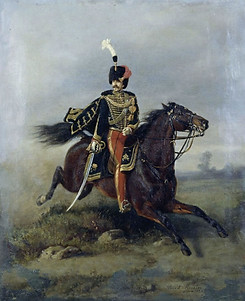
This seal bears the arms of the de Gombault de Razac family, a French noble lineage originating from the Guyenne and Bordeaux regions. The family held the barony of Razac-d'Eymet (in Dordogne) and produced notable figures, including Joseph de Gombault de Razac, a chevalier of the Bordeaux parliament in the 18th century. The lineage became prominently intertwined with French history and military records. For instance, Captain Gabriel de Gombault-Razac (1824–1888) served in the Guides of the Guard and the 15th Regiment of Dragoons in Béziers. His portrait as a cavalry officer was painted by German artist Ernst Meister (known as Le capitaine de Gombault-Razac, du régiment des guides). Members also married into other prominent French aristocratic families, such as the de Châteaubriand du Plessis line. The family had the title of Baron, but this seal may have belong to the wife or daughter of Etienne (1661 - 1721), who was Count of Bénauges.


Act of marriage of Joseph de Gombault-Razac

Arms of the de Gombault de Razac family
Capitaine de Gombault-Razac
Ref 355 - ♥♥♥♥♥
This seal may be attributed to the ancient noble family de Saisseval, whose origins lie in the village of Saisseval in Picardy, near Amiens. Mentioned in medieval records as early as the eleventh century, the family ranks among the oldest noble houses of the region. The documented genealogy begins with Gilles de Saisseval, Lord of Pissy, in the fourteenth century, while later generations became prominent landowners and served the French Crown in both military and civil capacities. Over the centuries, the family divided into several branches, notably those of Pissy, Blérancourt and d'Anville. The Pissy branch became the principal surviving line and was successively distinguished with the titles of Count and later Marquis de Saisseval. Although many family members continued to be described simply as écuyer - the traditional designation for members of the untitled nobility - others bore higher hereditary titles according to their branch and period.


Charlotte Hélène de Saisseval

Arms of the de Saisseval family

Claude-Jean-Henri de Saisseval
Ref 357 - ♥♥♥♥♥
This seal is engraved with the arms of the Aubourg de Boury family, whose origins lie in the Pays de Bray. The family is documented from the late Middle Ages and established itself as lords of Boury, from which one branch adopted the name Aubourg de Boury. Over the centuries, its members served the French Crown in both military and civil offices and were recognized among the old nobility of Normandy. Guillaume Aubourg, Counsellor to the King, Grand Audiencier of France and later created Marquis de Boury by Louis XIV, commissioned the construction of the present Château de Boury in the 1680s. Later generations included Charles Aubourg de Boury, 4th Marquis de Boury, and Ernest-Géraud-Charles Aubourg de Boury (1857–1940), deputy for the Eure, mayor of Amfreville-la-Campagne, agricultural leader and historian, who ended his life as a Benedictine monk and priest.


Guillaume Aubourg de Boury

ex-libris, Aubourg de Boury arms

Madame Aubourg de Boury
Ref 359 - ♥♥♥♥♥
This seal is engraved with the original arms of Matthias Ritter von Teng, rather than the more elaborate quartered arms found in nineteenth-century heraldic sources. The shield, charged with a winged caduceus and accompanied by two stars, is surmounted by the same distinctive crest, consisting of a caduceus set between two wings, confirming the attribution to the Teng family. Historical records indicate that Matthias Teng, a senior official of the Prince-Bishopric of Passau, received his diploma of hereditary nobility on 17 July 1788. It is therefore likely that the quartered coat of arms, which combines the Teng arms with a second shield bearing a half-eagle and is surmounted by two crests, was created as part of this ennoblement rather than through marriage. Such augmentations were common in the Holy Roman Empire, where newly ennobled officials often received more elaborate heraldic achievements. The seal, however, preserves only the original Teng arms. The quartered arms represented the full heraldic achievement granted with the patent of nobility.


von Teng tomb

Quartered arms, full heraldic von Teng achievement

Josef von Teng, Mayor of Munich
Ref 362 - ♥♥♥♥♥
This seal with its elegant wooden handle is engraved with arms similar to those of the Kustosch von Zubří und Lipka family (Czech: Kustoš ze Zubří a Lipky), an old Bohemian noble family whose history extends over several centuries. The family belonged to the landed nobility of the Kingdom of Bohemia and derived its name from the estates of Zubří and Lipka. Its position was strengthened in 1557, when Jan Kustoš acquired the estate of Lipka, where the medieval fortress was subsequently transformed into a Renaissance château that remained an important family seat for more than 150 years. The family gradually rose within the Habsburg nobility. In 1630, Emperor Ferdinand II elevated the Kustoš family to the rank of Baron (Freiherr). Nearly a century later, on 28 February 1725, Emperor Charles VI raised Ferdinand Adam Kustosch von Zubří und Lipka to the dignity of Count (Graf). The count’s coronet engraved above the shield therefore suggests that this seal belonged to a member of the family after its elevation to comital rank.


Ref 364 - ♥♥♥♥♥
This seal bears a coat of arms that appears characteristic of Central or Eastern European heraldry. The armored arm wielding a sword is a particularly common motif in Hungarian heraldry, although it was also used elsewhere in the Habsburg lands and therefore cannot, by itself, establish the geographical origin of the arms. The family represented by these arms has not yet been identified. The coronet of only five pearls may indicate that the arms belonged to an untitled noble family.


Ref 368 - ♥♥♥♥♥
The arms engraved on this seal point to the von Hieronymi family. Its composition corresponds with the arms recorded in 19th century German armorials. A particularly important figure was Johann Friedrich Heinrich von Hieronymi (1767–1836), a physician who served at the Mecklenburg-Strelitz court. His line appears to be connected with the noble family represented in these armorials. The family’s noble status was formally recognized in the early 19th century, although older branches of the Hieronymi name were already established in northern Germany before that period. There is a discrepancy in the tinctures, however. In the published armorials, the shield is shown Or, with a chevron Gules, whereas the seal appears to show Azure and Gules. Given the otherwise exact correspondence of the charges and crest, this difference is unlikely to indicate an unrelated family. It may instead point to a different branch or variant of the von Hieronymi family, using modified tinctures. The engraved letter H refers to Hieronymi, while A may represent the Christian name of the individual owner.


Ref 373 - ♥♥♥♥♥
This intriguing seal is engraved with the coat of arms traditionally associated with Jeanne d’Arc: A sword placed upright, its point supporting or piercing a crown, accompanied by two fleurs-de-lis. The design is generally understood as referring to Jeanne's extraordinary role in restoring Charles VII: The sword representing Jeanne and her military mission, the crown representing the king, and the fleurs-de-lis the French monarchy. The arms are associated with the remarkable events of 1429, when Jeanne helped raise the siege of Orléans and accompanied Charles VII to his coronation at Reims. In December of that year, Charles VII ennobled Jeanne's parents, Jacques d’Arc and Isabelle Romée, together with her brothers Jacquemin, Jean and Pierre and their descendants. The privilege was exceptional in extending nobility through both male and female descendants. Jeanne herself left no descendants. Her brothers, however, did, and Jean and Pierre d’Arc became known as du Lys. Later descendants and claimed descendants of the family consequently appear under the name du Lys, as well as under other surnames through female lines. A seventeenth-century royal document concerning Charles and Luc du Lys explicitly refers to the descendants of Jeanne's brothers carrying the name and arms of du Lys. The seal could have belonged to a member or descendant of the du Lys family, but it might equally represent a reproduction of the celebrated arms associated with Jeanne. Interestingly, the seller of this seal acquired it together with a statue of Pierre Cauchon, who was the principal judge in the trial of Jeanne d’Arc at Rouen. Jeanne was burned at the stake on 30 May 1431.


Jeanne d'Arc on the stake

The arms of Jeanne d'Arc and her family, who took the name du Lys
Ref 376 - ♥♥♥♥♥
This seal could be attributed, although without certainty, to Antoine-Jean-Baptiste-Alexandre Jullien and his wife, Élisabeth Baudon. Several elements support this hypothesis. The arms on the right correspond closely to those of the Jullien family, while an archival engraving showing essentially the same arms identifies a Mr Jullien as Procureur Général des Eaux et Forêts de France, an office held by Antoine. The arms on the left provide another compelling clue. Antoine married Élisabeth Baudon in 1748, and the Baudon arms feature the same principal charges visible on the seal: a pelican and a radiant sun. There is, however, an important discrepancy. In the recorded Baudon arms, the sun appears towards the dexter side of the chief, whereas on the seal it is positioned centrally above the pelican. This may simply reflect an adaptation by the engraver, but other families used such arms with a centered sun, for example the Franchet d'Esperey family. But with only one marriage documented, the Jullien - Baudon alliance remains a strong, however still unconfirmed, attribution.


Ref 377 - ♥♥♥♥♥
This seal could possibly be attributed to the Besler family, whose distinctive arms feature a kneeling winged angel holding a branch. This unusual heraldic figure appears in the Insignia Besleriana of Basilius Besler (1561–1629), the celebrated Nuremberg apothecary and botanist. An imperial record preserved in the Austrian State Archives confirms that Hieronymus Besler, Doctor of Medicine, and Basilius Besler were elevated to the knightly nobility of the Holy Roman Empire on 16 April 1608, receiving an augmentation of their coat of arms (Wappenbesserung). Further confirmation appears in Siebmacher's Wappenbuch, in the volume devoted to extinct Bavarian nobility. Its illustration closely resembles the seal, showing the same kneeling angel and a crest consisting of two raised wings. There is however a noticeable difference between the seal and the archive images. The Siebmacher crest includes two crossed objects between the wings, absent from the seal. Such variations may reflect simplifications made by the engraver. The angel's reversed orientation must also be considered in relation to the resulting wax impression. The seal is considerably more contemporary than Basilius Besler's lifetime, or even his nephew Michael Rupert, and therefore could have belonged to a subsequent member of the family. The owner of the seal remains unidentified, and more research is needed.


Michael Rupert Besler
Nephew of Basilius
In Early Modern German, Beslerin would be the feminine form of Besler: Barbara was a woman belonging to the Besler family and could be referred to as Beslerin. Many German surnames were given an -in ending when referring to a woman.

Gerry's Collection of Antique Seal Stamps.