


The Black Collection
Antique wax sealing stamps with black ebonized wood handles, mostly turned from hardwoods

Ref 292 - ♥♥♥♥♥
Research relating to this old seal could suggest a possible - though unconfirmed - connection between a family known as de La Fitte (also written de La Fite) and a modern Armagnac brand. The de La Fitte family was an established noble house of Guyenne, Gascogne, and Bigorre, with documented origins reaching at least the 12th century and a continuous filiation from the 15th century. It belonged to the provincial nobility and held numerous seigneuries, including Urac, Omex, Clavé, and Moulya, with a territorial presence between Aiguillon and Villeneuve. The family appears primarily of military character, producing officers, governors, and chevaliers of royal orders, and holding representation in the Estates of Bigorre. Titles within the lineage are historically attested: a comital title granted under Louis XIV, followed by the creation of a marquisate within the same house. A related branch, known as de La Fite (or de La Fitte) de Pelleport, appears in later sources and is generally considered part of the broader family, despite variations in spelling. The Armagnac brand Comte de Lafitte - interestingly - uses very similar arms. However, no reliable source could confirm a genealogical connection between this noble family and the modern brand. More research is needed.


Ref 293 - ♥♥♥♥♥
This seal was very likely used by Benjamin de Lacger-Camplong (1784–1831) and Adélaïde de Perrin-Brassac (1795–1862), whose marriage in 1821 provides a strong historical context for its creation. The engraved composition displays an alliance of arms that can be read with confidence. On the left appears the coat of arms of the de Lacger family - azure with a lion and a chief charged with three roundels -while on the right are arms consistent with the Perrin or Perrin de La Fabrie lineage, characterized by horizontal fasces. The style and execution of the seal, notably the twin oval shields, supporters, and coronet, point to a production in the late eighteenth or early nineteenth century, which aligns well with the period of this documented union. Earlier alliances between the Lacger and Perrin families, such as that of 1576, can therefore be excluded on stylistic grounds. A more elaborate quartered arms associated with the Lacger-Camplong family branch incorporate several allied families, including Perrin, confirming the long-standing connection between these lineages. The seal simplifies this heraldic complexity into a direct marital alliance, as was customary. Although the coronet engraved above the shields corresponds to that of a count, whereas Benjamin de Lacger is recorded as a baron, such discrepancies are not uncommon. Heraldic practice on seals was sometimes approximate, and engravers occasionally used generic noble coronets. Taken together, the heraldic evidence, stylistic dating, and genealogical records make this attribution both coherent and highly plausible.


Ref 305 - ♥♥♥♥♥
This seal, unfortunately broken at its base, bears the arms of the d’Ornano family, an old Corsican noble house rooted in the Ornano and Taravo region, south of Ajaccio. The family’s rise is connected to Sampiero Corso, born around 1498, an early figure associated with Corsican resistance to Genoese rule. He married Vannina d’Ornano, heiress of the Ornano lineage, and from this union emerged the later French line, combining military distinction with established local nobility. Their son, Alphonse d'Ornano (1548–1610), entered royal service during the Wars of Religion and was made Marshal of France. He played a decisive role in integrating the family into the service nobility of the French monarchy. In the Napoleonic period, Philippe Antoine d'Ornano (1784–1863), born in Ajaccio, revived the family’s prominence. A relative of Napoleon Bonaparte, he served with distinction, was created Count of the Empire in 1808, and later Marshal of France. His father, Louis-Antoine d’Ornano (1744–1816), had married Isabella Maria Buonaparte, a member of the Ajaccio Bonaparte family, thereby reinforcing this connection. The arms evolved from an older Corsican form - gules, a triple-towered castle or, with two lions affronted at the gate, to a French quartered coat: 1 and 4, gules a tower or; 2 and 3, or a lion gules with a chief azure charged with a fleur-de-lis or. Under the Empire, the arms of Philippe Antoine incorporated a central escutcheon and Napoleonic augmentations.


.jpg)


Philippe-Antoine d'Ornano, Count of the Empire
Seal engraved with the d'Ornano coat of arms
-comtesse-d'Ornano.jpg)
Countess Marie d'Ornano
Ref 306 - ♥♥♥♥♥
This seal bears the alliance arms of Jules de Courtarvel and Élisabeth Guéau de Gravelle de Reverseaux. The Courtarvel family, held the titles marquis de Pezé, de Saint-Rémy et de Courtarvel and possessed numerous seigneuries, including La Lucazière, Saint-Germain, Baillou, Valennes, Boursay, Trémigon, Verdes, Boisgency, Monterestin and Lierville. Originating in Maine, they counted several members within the Sovereign Order of Malta, particularly in the 17th and 18th centuries, attesting to their established nobility and tradition of service. André de Courtarvel is recorded in 1618, and four sons of René César de Courtarvel are likewise mentioned as knights of the Order. The seal's engraving also presents an interesting feature concerning the arms of the Guéau family. The arms of the Guéau de Gravelle de Reverseaux branch were normally quartered, following the transmission of name and arms within the family. On 14 December 1717, Marin de Gravelle transferred the estate of Reverseaux to his nephew Philippe Guéau, on condition that he adopt the name and arms of “de Gravelle” and transmit the estate by male primogeniture. The family thereafter adopted the composite name and quartered arms. On this seal, however, only the arms of Courtarvel and Guéau de Reverseaux appear, without the Gravelle quarters, likely reflecting a simplified rendering suited to the limited space of the matrix.


Ref 307 - ♥♥♥♥♥
This seal belonged to Alfred du Boisbaudry and Jeanne-Marie de La Croix de Beaurepos. The du Boisbaudry family is an old Breton lineage of ancient extraction, with proven filiation from 1377. It takes its name from the seigneury of Boisbaudry, in the parish of Rimou near Rennes, and appears in the réformations and montres of the dioceses of Dol and Rennes in the 15th and early 16th centuries. Its nobility was maintained in 1668 by the Chambre de réformation of the Parlement of Brittany. Before the Revolution, it sought the honneurs de la Cour, reflecting a solid position within the provincial nobility. The family held seigneuries such as Trans, Langan, and La Hussaudière, and produced figures including Gilles du Boisbaudry, avocat général, and François-Dominique du Boisbaudry, conseiller. Its arms are: Or, two fesses sable, the first charged with three and the second with two bezants argent, with greyhound supporters. The de la Croix de Beaurepos family originated in the Orléanais, settled in the Comtat Venaissin in 1525, and later in Maine. It bore the hereditary title of Comte de Beaurepos, maintained in 1670. Its arms are: Or, three wavy fesses azure, surmounted by a demi-lion gules. Genealogies recorded by d’Hozier trace the line to the 15th century, with members serving as officers and royal servants. The seal is accompanied by an old wax impression of the arms affixed to a handwritten note identifying both families.


Antoine du Boisbaudry (1892 - 1964)

Alliance arms Boisbaudry and Croix de Beaurepos
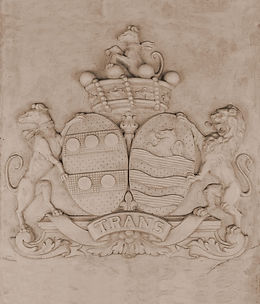
Arms at the Château de la Ville Der
Ref 310 - ♥♥♥♥♥
This seal is engraved with the arms of the Csák von Uray family, from the Kingdom of Hungary. The original Csák family, whose own arms used a shield depicting a lion rampant, was divided into 12 branches. The von Uray branch derives from the locality of Uray in Gömör County. The family’s nobility was formally confirmed or renewed by a charter dated 19 March 1639. Their coat of arms shows a lion holding a sabre, a typically Hungarian martial symbol, with a crest of a crane holding a stone, representing vigilance. The family appears mainly in regional and ecclesiastical roles rather than in high political office. Notable members include Stefan Csák von Uray, canon of Eger, and Gerard Csák von Uray, provost of Jászó (now Jasov) in the late 18th century.


Ref 311 - ♥♥♥♥♥
This seal belonged to a member of the Thiroux family, an old French lineage of the noblesse de robe prominent from the 17th century onward. The family appears initially as a bourgeois and legal dynasty, notably through Denis Thiroux, a renowned lawyer and civic leader in Autun (Burgundy). His services enabled the family’s advancement, culminating in letters of nobility granted in 1669 to his son Claude Thiroux by Louis XIV. Their status is therefore characteristic of the robe nobility: rooted not in feudal antiquity, but in office and royal service. Several branches developed, including Thiroux d’Arconville, de Crosne, de Villemesle, and de Gervillier. Among the notable figures of the family were Louis-Lazare Thiroux d’Arconville (1712–1789), President of the Chambre des enquêtes of the Parlement of Paris, Marie-Geneviève-Charlotte Thiroux d’Arconville (1720–1805), an unusually prominent woman of letters and scientist, and Louis Thiroux de Crosne (1736–1794), last Lieutenant General of Police of Paris before the Revolution, later executed during the Terror.


Louis Thiroux de Crosne

Coat of arms of the Thiroux family

Jean-Louis Thiroux
Ref 312 - ♥♥♥♥♥
While more research is needed to confirm it, the alliance arms on this seal could be the ones of Louise Marie Alexandrine Lemaire de Marne and Viscount Louis de Laire d'Espagny. The Lemaire de Marne family was a French lineage established in the regions of Flanders and Artois, particularly around Douai, during the 18th and 19th centuries. Its members belonged to the educated administrative elite, combining legal training, royal service, and landownership. Jules Lemaire de Marne (1737–1811) held offices connected with the Parlement of Flanders and the royal artillery, reflecting a position of notable local importance. The family possessed estates and urban properties, and participated actively in civic and religious life. In later periods, members of the family were styled counts (comtes), a title that appears in portraits and modern notices, and which reflects their recognized social standing, even if its formal origin remains uncertain.


Louis Jules César Lemaire de Marne


Marriage of Edwin Lemaire de Marne
Jean Joseph Edwin Lemaire de Marne
Ref 315 - ♥♥♥♥♥
This is a seal of the Taverne family, later styled Taverne de Renescure or de Montdhiver. Originally from Thérouanne, the family settled in Dunkerque around the mid-16th century, following the destruction of the city during the wars of Charles V. By the 17th century, figures such as Nicolas Taverne and his descendants were active as merchants, armateurs, and members of the Chamber of Commerce. Their growing wealth enabled the acquisition of offices and lands, a common path toward social elevation. The decisive step occurred in the early 18th century, when Jean-Nicolas Taverne purchased the seigneury of Renescure (1720) and held offices connected to royal administration, consolidating the family’s status as écuyers. His son, Jacques-Joseph-Nicolas Taverne was mousquetaire of the King, lieutenant at Hondschoote, and bourgmestre of Dunkerque, while holding several seigneuries. A collateral branch, Taverne de Tersud, continued in military and administrative careers, including émigré officers and decorated cavalrymen.


Ref 324 - ♥♥♥♥♥
This seal is engraved with the arms of the Fornerod d’Avanche family, an old Swiss lineage associated with the region of Avenches in the canton of Vaud. The territorial designation “d’Avanche” refers to the historic town of Avenches — ancient Roman Aventicum — while the surname Fornerod appears in western Swiss records from the early modern period onward. According to later genealogical traditions, the family may originally have had connections with Savoy before becoming firmly established in Vaud and Lausanne. The family belonged to the educated Protestant patrician elite of French-speaking Switzerland rather than to the medieval feudal aristocracy. Over the centuries, members served as magistrates, syndics, judges, landowners, officers, churchmen, and public administrators. Heraldic sources even attribute to the family two bishops of Lausanne, whose tombs and armorial bearings were formerly visible in the cathedral. The family reached national prominence in the 19th century through Constant Fornerod (1819–1899), member of the Swiss Federal Council and President of the Swiss Confederation in 1869.


Ref 327 - ♥♥♥♥♥
This seal possibly bears the arms of the Perrot de Thannberg family, a noble house claiming origins in the Tyrol before later establishing itself in Franche-Comté and the Île-de-France. The family combined the names and arms of the Perrot and Thannberg lineages. Their heraldry reflects this union: the Perrot arms display crescents or stars, while the Thannberg arms feature three fir trees, alluding to the alpine meaning of “Tannenberg” (“fir-tree mountain”). Several genealogical sources describe the family as Counts of Thannberg, with branches also styled Marquis and Counts of Fercourt. Although belonging more to the service nobility than to the ancient sovereign aristocracy, the family achieved distinction through military, administrative, ecclesiastical, and court service. The seal differs slightly from the documented arms, showing thirteen stars in the chief instead of the usual nine. Such variations may reflect heraldic differentiation between branches, a personal modification, or possibly an augmentation connected with military distinction.


Ref 328 - ♥♥♥♥♥
This seal could have belonged to a member of the Grabinstaden family. The attribution is based on the close similarity between the engraved arms on the seal and several heraldic representations associated with the Grabinstaden name. The seal displays a shield divided horizontally, with a star placed in the upper portion and a crest consisting of two wings emerging above a helmet. These features correspond closely to armorial depictions of the Grabinstaden arms found in historical records. A notable example is the coat of arms granted to Johann Jakob Grabinstaden, councillor to the Counts of Hanau-Lichtenberg, which shows a shield of similar composition together with a crest formed by two wings. Another armorial source labelled “Die Grabinstaden” depicts essentially the same heraldic arrangement. Although the engraved seal appears to show a wavy line separating the two halves of the shield, whereas armorial illustrations show a straight division, such variations are not uncommon in seal engraving and do not necessarily indicate a different family.


Ref 337 - ♥♥♥♥♥
This seal is engraved with the Syrokomla coat of arms, one of the oldest and most widespread heraldic emblems of the Polish-Lithuanian nobility. Unlike the heraldic traditions of Western Europe, where arms generally belonged to a single family, Polish heraldry was based on heraldic clans, allowing numerous unrelated noble families to share the same arms. The Syrokomla coat of arms is first documented in 1354 and was eventually borne by approximately 95 noble families, among them the Grocholski, Bułhak, Gucewicz, and the family actually named Syrokomla. According to tradition, the cross above the ancient Abdank emblem was granted in recognition of a knight's defence of the Christian faith, although this story is now regarded as legendary. Without additional inscriptions, the present seal cannot be attributed to one specific family, but rather to a member of the distinguished Syrokomla heraldic clan.


Władysław Syrokomla

A version of the Syrokomla coat of arms

Remigian Grocholski
Ref 342 - ♥♥♥♥♥
When I purchased this seal, I thought it would be one of the easiest in my collection to identify. The engraved coat of arms is simple: a shield charged with a fess between two ducks in chief and two stars in base. Surprisingly, however, despite consulting heraldic references, I have so far been unable to identify the family with certainty. Perhaps one day another collector or researcher will recognise these arms and provide the missing clue.


Ref 346 - ♥♥♥♥♥
This seal bears the arms of the Percy family, one of the oldest and most influential aristocratic houses of England. The principal shield is quartered: the first and fourth quarters display a lion rampant, while the second and third bear the familiar Percy arms of five lozenges in fess. The achievement is completed by the traditional supporters, two distinct crests, and the motto « Espérance en Dieu » ("Hope in God"). The French wording reflects the enduring influence of Anglo-Norman culture upon the English aristocracy, where French remained the language of chivalry and heraldry for centuries after the Norman Conquest. The Percys rose to exceptional prominence in northern England, becoming Earls and later Dukes of Northumberland. From their great seat at Alnwick Castle they exercised immense military, political, and territorial influence. Members of the family served as royal councillors, commanders, and Wardens of the Scottish Marches, while figures such as Sir Henry "Hotspur" Percy became legendary in English history.


The seal, however, appears to belong not to the English ducal house itself but to the Belgian branch of the Percy family. This branch, of British Catholic origin, settled in the Southern Netherlands and was officially recognised among the Belgian nobility during the nineteenth century. Belgian armorials illustrate arms virtually identical to those engraved on this seal, including the unusual second crest depicting a Moor's bust (« un buste de Maure vêtu de pourpre, tortillé d'argent »). This distinctive crest closely resembles the figure engraved above the right-hand helmet on the seal, providing a strong indication that it belonged to the Belgian Percy lineage rather than to the English main branch alone.
The most intriguing feature remains the small central escutcheon...
Earlier, it seemed likely to represent the arms of an English marital alliance, perhaps with the medieval Poyntz family. However, further research suggests a more convincing explanation. The Belgian Percy family descended from George Percy (d. 1817), who married Jeanne-Marie Thor Horst (d. 1809). The Thor Horst arms are blazoned Or, three fesses Sable, a design that corresponds closely to the shield engraved on the escutcheon. It is therefore possible that George Percy combined his ancestral Percy arms with those of the Thor Horst family, creating a distinctive achievement for his Belgian branch. Over time, this composition may have become the recognised "full arms" (armes pleines) of the Belgian Percys, explaining why the escutcheon also appears in nineteenth-century Belgian heraldic sources.
Although this interpretation fits the available evidence remarkably well, it has not yet been confirmed by an official blazon or contemporary document explicitly stating the origin of the escutcheon. Whether it commemorates the Thor Horst marriage, an inheritance, or another family connection, the precise reason for its inclusion remains uncertain. Until further documentary evidence emerges, the identity and significance of the central shield continue to represent one of the most fascinating mysteries surrounding this remarkable seal remains to be discovered.


Ref 350 - ♥♥♥♥♥
This seal records the alliance between Thomas Colas-Brouville de Malmusse (1790–1853) and Clotilde Félicité Jordan (1796–1872). The Colas family was an ancient noble house of the Orléanais, with proven nobility dating from the fourteenth century. Over the centuries its numerous branches acquired estates such as Brouville, Malmusse, Marolles, and Rocheplatte, while many of its members served as mayors of Orléans, councillors, magistrates, military officers, and royal administrators. The family was confirmed in its noble status by Louis XIV in 1670. The Jordan family originated in Languedoc before establishing branches in Lyon, Burgundy, and the Avallonnais. Several of its members held important judicial and administrative offices, including positions as secretaries to the king and officials of the Parlement of Dijon.


Ref 366 - ♥♥♥♥♥
This seal bears a complex composition which combines ancestral heraldry, historical symbolism and personal military distinction. There is a strong possibility that it belonged to Ruprecht Freiherr Böcklin von Böcklinsau (1875 - 1955), a member of an old Alsatian family and a German officer during the First World War. The shield indeed corresponds closely with the arms of the Böcklin von Böcklinsau, traditionally represented as a silver rearing goat on a red field. The family belonged to the ancient patriciate of Strasbourg and later to the nobility of the Holy Roman Empire. The remaining elements, however, do not constitute the family's ordinary heraldic achievement. Instead, they may form a composite personal emblem, combining the owner's ancestral arms with symbols referring to different aspects of his identity. Behind the shield appears a crowned double-headed eagle, holding a sword in one claw and a scepter in the other. Above its two heads is a large imperial-style crown. This imagery belongs to the heraldic tradition of the Holy Roman and Habsburg imperial world. In the context of this seal, the eagle may therefore have been intended as a reference to the family's historical roots within the old Empire rather than as part of the Böcklin arms themselves. Behind the entire composition is a large cross pattée. Its shape corresponds with the Iron Cross (Eisernes Kreuz). This identification provides perhaps the most intriguing clue to the seal's possible owner.
A member of the family was Ruprecht Freiherr Böcklin von Böcklinsau.


Holy Roman Empire double-headed eagle

Wolf Böcklin von Böcklinsau

Arms of Böcklin von Böcklinsau.

Ludwig Böcklin von Böcklinsau

Iron Cross: General of Infantry Freiherr Böcklin von Böcklinsau to his brave son Ruprecht, 1914
Born in 1875, Ruprecht was a serving officer during the First World War and the son of Ludwig August Gallus Freiherr Böcklin von Böcklinsau (1838 - 1922), a distinguished Prussian General der Infanterie. Ludwig himself had received the Iron Cross 2nd Class for his service during the Franco-Prussian War of 1870 - 71. Even more significantly, an original Iron Cross 1st Class of 1914 survives, and bears a personal inscription from Ludwig to his son: “General der Infanterie Freiherr Böcklin von Böcklinsau seinem tapfern Sohne Ruprecht 1914” (General of Infantry Freiherr Böcklin von Böcklinsau to his brave son Ruprecht, 1914). This provides a direct and unusually personal connection between Ruprecht and precisely the military decoration apparently represented behind the arms on the seal. The composition can therefore be understood as a visual expression of several layers of identity. The central shield represents the Böcklin family, the double-headed imperial eagle evokes the family's historical connection with the old Imperial world, while the Iron Cross refers to more recent military service and distinction. Rather than being an official coat of arms in the strict heraldic sense, the engraving may have been deliberately conceived as a personal emblem bringing these different traditions together.
Ref 367 - ♥♥♥♥♥
This seal bears interesting arms that have not yet been identified. Above the helmet, the crest shows horns, a feature frequently encountered in Central European heraldry. The seal was acquired in Hungary, suggesting a possible origin within the former Austro-Hungarian or Germanic heraldic sphere, although this remains uncertain. Similar combinations of mounted warriors and fortifications can be found in several European armorial traditions. Further research is necessary.


Ref 369 - ♥♥♥♥♥
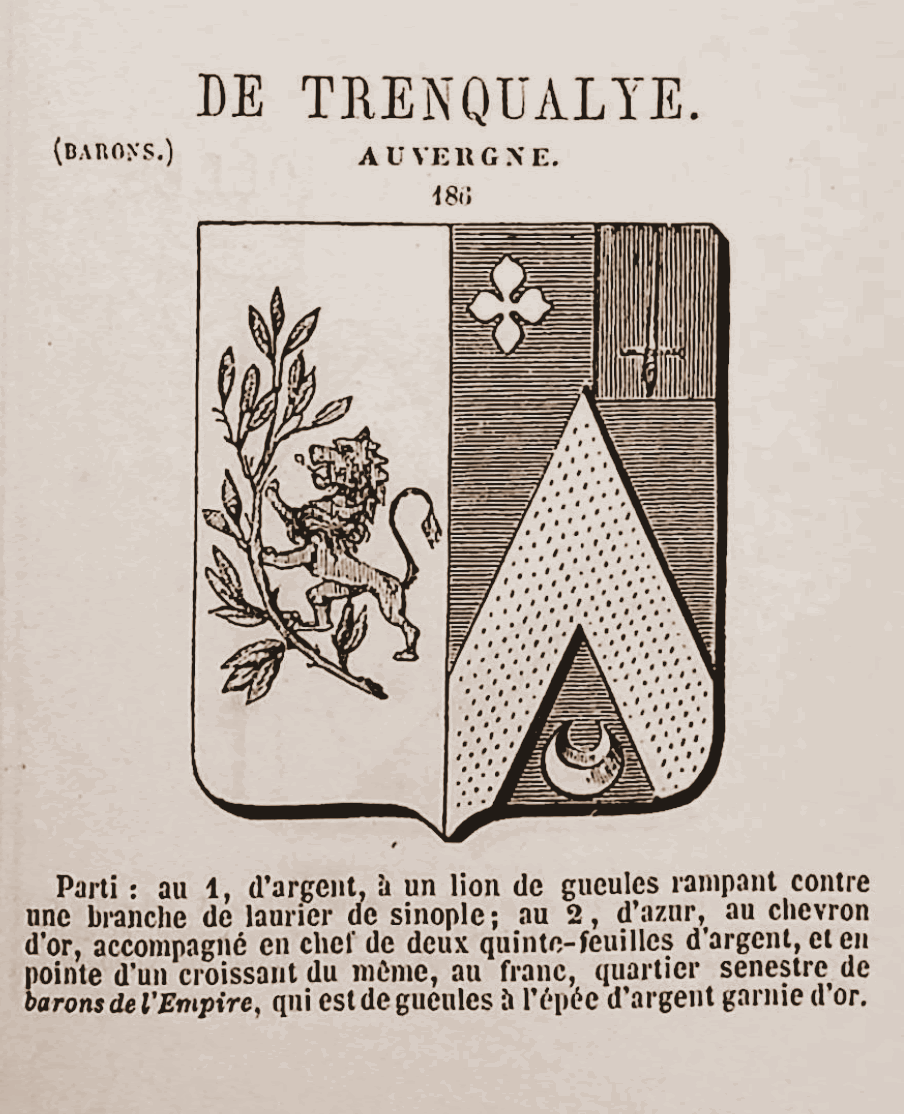
This seal bears the alliance arms of the parents of the Baron of the Empire Alexis de Trenqualye: Jean-Henri-Alexis de Trenqualye (1735 - 1820) and Madeleine Bouchard de Florat, or Florac. Jean-Henri-Alexis was an infantry officer in the Régiment de Riom, while Madeleine belonged to the Bouchard family of Auvergne. The subsequent history of these arms is particularly interesting. Their son, Anne-Alexis-Jean de Trenqualye (1772–1852), pursued an important military and political career. Having entered military service in 1789, he served during the Revolutionary and Napoleonic period, rose to the rank of adjudant-commandant, and became a Commandeur de la Légion d'honneur. Napoleon created him Baron of the Empire on 15 June 1810. After the Restoration he was also made a Knight of Saint-Louis and later represented the Puy-de-Dôme in the Chamber of Deputies. It was with this generation that the family's heraldry acquired the form found in later armorials, combining the two coats displayed separately on his parent’s marriage seal. The shield is parti: the first half bears the Trenqualye lion and laurel branch, while the second bears the Bouchard chevron, flowers and crescent. Thus, the heraldic alliance represented by two separate shields on the parents' seal was subsequently brought together within a single shield in the arms of their son. This makes the seal especially interesting from a heraldic point of view.




Ref 370 - ♥♥♥♥♥
This seal is engraved with a coat of arms of the Mylius family that appears to have been adapted or augmented, most likely in a French context. While the Mylius family was originally of German origin, the addition of a sword in the chief together with a baronial coronet suggests a heraldic modification associated with military distinction or noble recognition in the Napoleonic period. Archives indeed mention a “Baron de Mylius” in 1814, serving as an Austrian general during the occupation of the city by allied forces. Several members of the family - including branches later styled Mylius von Ehrengreif or Mylius d’Ehrengreiff - became established in France. A notable figure was Ernest Albert Henri de Mylius (1749–1805), a German-born officer who served during the French Revolutionary wars. His military career may explain the presence of the sword added to the arms.


Gerry's Collection of Antique Seal Stamps.