


Noble Anecdotes
Stories, legends, and curious tales from Europe's noble families

Through its seal and coat of arms, every family featured on the website of my collection of antique seals possesses a long and often fascinating history. This section focuses on anecdotes rather than broad genealogies. Here you will find tales of unusual or eccentric relatives, dramatic inheritances and succession disputes, acts of bravery, scandals, curious family legends, ghost stories, and remarkable acts of generosity or cruelty.
The anecdotes are classified following the family names' alphabetic order.


Panouse (de la) Ref 291

He Brought Lions to His Castle
In the 1960s, Count Jean de La Panouse inherited the Château de Thoiry, west of Paris. Like many aristocratic estates in post-war France, the château was expensive to maintain, and the family faced the challenge of preserving a historic property with limited resources. Rather than selling the estate, Jean de La Panouse came up with an idea that many considered completely mad: he would create a safari park around the château and allow visitors to drive among free-roaming wild animals. The concept was revolutionary in France. Lions, zebras, antelopes, and other exotic animals were introduced to the estate while visitors remained safely in their cars. The experiment succeeded beyond expectations, and Thoiry became the first safari park of its kind in France. Many traditional aristocrats regarded the project as eccentric. Yet the venture saved the estate and transformed it into one of the country's best-known wildlife parks.
Why it is memorable: Most noble families inherited castles. Jean de La Panouse inherited a castle and brought lions to it. What initially seemed like a wildly unconventional idea not only preserved the family estate but also created one of France's most innovative attractions. Few aristocrats can claim that their solution to financial difficulties involved filling their park with lions.
Reininghaus (von) Ref 66

The Brewer Who Wrote Poetry
During the late nineteenth century, Johann Peter von Reininghaus became one of the most successful industrialists in Austria. His brewery near Graz grew into a major enterprise, and his name became associated with economic progress and prosperity throughout the region. Visitors arriving at the Reininghaus estate expected to encounter a typical industrial magnate surrounded by ledgers, machinery, and business concerns. Instead, they often discovered a man with a passion for literature, art, and poetry. Johann Peter was not only a chemist, entrepreneur, and manufacturer; he was also a poet. One local story recounts that a guest, surprised by the refined atmosphere of the household, remarked that he had expected to meet a brewer and had instead met a poet. Reininghaus reportedly accepted the observation with satisfaction. Together with his wife, Theresia Mautner von Markhof, he transformed their residence into a gathering place for artists, writers, musicians, and intellectuals. Conversations that began with brewing, chemistry, or industry often ended with discussions of literature, painting, or music. Their home became one of the cultural meeting places of Graz, attracting figures from both the artistic and business worlds.
Why it is memorable: The story is memorable because it overturns expectations. The owner of one of Austria's great breweries was not solely concerned with commerce and industry. Alongside his business achievements, Johann Peter von Reininghaus cultivated poetry, supported the arts, and helped create a cultural salon where ideas, creativity, and industry could meet under the same roof.
Robertson of Kindeace Ref 107

The Chief Stole His Own Cattle
Few Highland chiefs embodied the turbulent spirit of the Jacobite age more completely than Alexander Robertson of Struan (1670–1749), chief of Clan Robertson and head of the wider family from which the Robertsons of Kindeace descended as a cadet branch. Struan took part in the Jacobite Rising of 1715. When the rebellion failed, he was forced into exile and spent years away from his ancestral lands while government authorities confiscated his estates. When he was eventually able to return, he discovered that neighboring landowners and opportunistic rivals had taken advantage of his absence to appropriate cattle and other property that the Robertsons considered their own. In the Highlands, cattle represented wealth, status, and survival. Their loss was not a trivial matter. Rather than pursuing a legal dispute, Struan reportedly chose to gather a party of loyal clansmen, and organized a raid to recover the disputed cattle himself. To outside observers, it may have appeared that the chief was stealing cattle. To Struan, however, he was merely taking back what already belonged to the Robertsons. Whether every detail is literally true is difficult to establish today. Like many Highland stories, the tale was passed down through generations and undoubtedly acquired embellishments along the way.
Why it is memorable: The anecdote perfectly captures the character of Alexander Robertson of Struan. He was not a man inclined toward patience, compromise, or legal formalities when he believed an injustice had been committed. Rebel, exile, poet, and clan chief, he often behaved as though the old Highland code of honor carried more weight than official institutions. The story would have been familiar to branches of the clan such as the Robertsons of Kindeace, who shared in the traditions and identity of the wider Robertson family.
Ruty Ref 47

The General Who Preferred Mathematics to Glory
Many Napoleonic generals became famous for their daring cavalry charges, dramatic battlefield exploits, or colorful personalities. Charles-Étienne-François Ruty was different. An artillery officer by training, Ruty earned a reputation among his contemporaries as a remarkably methodical and disciplined man. While other officers sought distinction in the heat of combat, he was often found studying maps, calculating artillery positions, and organizing the countless logistical details required to move and supply an army. One contemporary remarked that Ruty seemed more engineer than warrior. Yet this was precisely why Napoleon valued him so highly. The Emperor, himself a former artillery officer, understood that battles were not won by courage alone. Behind every victory stood men capable of calculating ranges, positioning guns, managing ammunition, and ensuring that thousands of soldiers received the support they needed at the decisive moment. Ruty excelled in this often overlooked work. He was not known for dramatic speeches or reckless bravery. Instead, he brought order, precision, and reliability to every task entrusted to him.
Why it is memorable: Ruty’s story shows a quieter kind of distinction. He was not remembered for theatrical bravery or political intrigue, but for precision, discipline, and practical intelligence. In the Napoleonic world, where glory often belonged to the most dramatic figures, Ruty represented the officer whose value lay in calculation, order, and competence.
Saltykov Ref 99
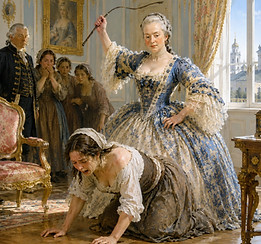
Russia's Most Notorious Murderer
The House of Saltykov produced statesmen, generals, diplomats, and ladies of the imperial court. Yet the most infamous member of the family was Darya Nikolaevna Saltykova, remembered to history as Saltychikha. Darya became a wealthy widow after the death of her husband in 1755. What followed shocked even eighteenth-century Russia. Over a period of many years, she subjected her serfs to brutal punishments. Witnesses later described beatings, torture, starvation, and other acts of cruelty directed primarily against young female servants. Numerous complaints were made, but her wealth, status, and connections allowed her to avoid punishment. The crimes might never have been exposed had two serfs, whose wives had allegedly died at her hands, not succeeded in bringing their petition directly to Empress Catherine the Great. An investigation followed. After years of inquiry, the authorities concluded that Saltykova had been responsible for dozens of deaths. In 1768, Catherine ordered a punishment designed to serve as a public lesson. Saltykova was displayed on a scaffold in Moscow beneath a sign identifying her as a torturer and murderer. She was then confined for the remainder of her life in the Ivanovsky Convent, where she spent more than three decades in imprisonment.
Why it is memorable: The case remains one of the most notorious criminal scandals in Russian history. It is remarkable not only for the scale of the crimes but also because the perpetrator was a wealthy noblewoman who believed her status placed her above the law. Her eventual conviction became a powerful symbol of Catherine the Great's determination to demonstrate that even members of the aristocracy could be held accountable for their actions.
Siam Ref 93

The Europeans Who Became Siamese Noblemen
During the reign of King Chulalongkorn (Rama V), Siam underwent a period of rapid modernization. To help reform the kingdom's administration, military, railways, and legal system, the King recruited a remarkable group of foreign advisers from across Europe. Several were granted Siamese noble titles, decorated with prestigious orders of the kingdom, and welcomed into the highest circles of the royal court. They learned the language, adopted court customs, and participated in ceremonies alongside Siamese princes and ministers. Visitors to Bangkok occasionally found the sight surprising. A European adviser might appear wearing a chest full of Siamese decorations, holding a noble title bestowed by the King, and speaking passionately about the future of Siam. Some foreign observers joked that these men had become "more Siamese than the Siamese". The transformation even appeared in their personal symbols. European-style seals, monograms, and armorial devices were sometimes adorned with Siamese orders, royal insignia, white elephants, or other symbols of royal favor. Their identities had become a blend of two worlds: European by birth, Siamese by service.
Why it is memorable: For centuries, noble identity and heraldry were deeply rooted in European traditions. Yet in late nineteenth-century Bangkok, a small group of foreigners created something entirely new. By combining European customs with Siamese titles, honors, and symbolism, they became living bridges between East and West and left behind one of the most unusual chapters in the history of aristocratic culture.
Spaun (von) Ref 3

They Quietly Saved Schubert
One of the most charming stories associated with the Spauns concerns Joseph von Spaun. When Schubert was a poor student in Vienna, he often lacked even the money to buy manuscript paper on which to write his music. Joseph von Spaun, who came from a comfortable noble family, noticed the young composer's situation and began quietly supplying him with paper and financial help. He also introduced Schubert to influential friends, invited him into aristocratic salons, and remained loyal throughout the composer's life. A later recollection noted that much of Schubert's early music was written on paper provided by Spaun. Without this seemingly modest assistance, some of Schubert's masterpieces might never have been composed at all.
Why it is memorable: The Spauns did not gain titles, lands, or political influence from this act. Instead, a noble family's generosity helped sustain a struggling musician who would later become one of Austria's greatest composers.
Straten Ponthoz (van der) Ref 104

A Belgian Count Chose Car Racing Over Carriages
For centuries, members of the van der Straten Ponthoz family had served as noblemen, diplomats, and public officials, later becoming a founding family of a major industry. Yet in the twentieth century, one member of the family, Count Rodolphe "Rudy" van der Straten Ponthoz, became known for something entirely different: motor racing. After the Second World War, he spent many years managing his plantation in the Belgian Congo before returning to Belgium. In 1964, he founded Racing Team VDS, the initials standing for Van der Straten. What began as a modest racing venture soon grew into one of Europe's most respected private teams. Racing Team VDS competed in touring cars, endurance racing, Formula 5000, Can-Am, and Indycar racing. The team attracted many of the leading drivers of its era and achieved victories on circuits across Europe, North America, and Australia. In the early 1980s he even became a racing-car manufacturer, producing the VDS 001 for the Can-Am championship. Few aristocrats could claim to have built a racing team capable of competing at the highest international level.
Why it is memorable: Many noble families adapted to the modern world through politics, industry, or finance. Count Rudy van der Straten Ponthoz also chose speed. Besides family business, he transformed an ancient aristocratic name into one of the most respected names in international motorsport, proving that the spirit of adventure could survive long after the age of horses and carriages had passed. Later on, other family members followed his example.
Tréton de Vaujuas Ref 34

The Nobleman Who Vanished with La Pérouse
François René Charles Tréton de Vaujuas was a promising naval officer from the family. He had already distinguished himself in the navy and earned the confidence of the famous explorer Jean-François de Galaup, comte de La Pérouse. La Pérouse thought so highly of him that he reportedly described him as "the most accomplished naval officer I have encountered since I entered the service". In 1785, Vaujuas joined the celebrated La Pérouse expedition, which was sent by Louis XVI to explore the Pacific and rival the discoveries of James Cook. The expedition sailed around the world, sending reports back to France from distant ports. Then, suddenly, all contact ceased. For decades nobody knew what had happened. Families of the officers, including the Tréton de Vaujuas family, were left in uncertainty. The disappearance became so famous that, according to a well-known tradition, even Louis XVI reportedly asked about La Pérouse's fate shortly before his own execution. Only many years later was it discovered that the expedition's ships had been wrecked near Vanikoro in the South Pacific. Vaujuas had perished there with many of his companions.
Why it is memorable: Unlike many noble officers who died in battle, François René Charles Tréton de Vaujuas simply vanished from the known world. For years his family had no explanation, only silence. His fate became part of one of the greatest maritime mysteries in French history, a story that captivated Europe long after the ships disappeared beyond the horizon.
Vane Ref 78

A Title Born from a Royal Affair
Few aristocratic titles have a more unusual origin than the Dukedom of Cleveland. The Vane family were the Dukes of Cleveland, one of the great aristocratic houses of northern England. Yet the title they bore had a far more unconventional beginning than most noble dignities. The title was first created in 1670 for Barbara Villiers, one of the most famous women at the court of King Charles II of England. Renowned for her beauty, ambition, and influence, Barbara was the King's most celebrated mistress and played a prominent role in the politics and intrigues of the Restoration court. Her relationship with Charles II became so important that the King granted her the title of Duchess of Cleveland, making her one of the most powerful women in the kingdom. Over time, however, the original creation became extinct. Nearly two centuries later, in 1833, the title was revived for the Vane family. From that point onward, the respectable and immensely wealthy Vanes became Dukes of Cleveland. But the intriguing historical detail remained; their ducal title ultimately traced its history back to one of the most famous royal love affairs in English history. Victorian society, with its emphasis on propriety and respectability, rarely drew attention to this connection. Nevertheless, historians have always found it amusing.
Why it is memorable: Many noble titles were earned through military service or inherited through centuries of family tradition. The Dukedom of Cleveland followed a far less conventional path. It began with one of the greatest scandals of the Restoration court before passing, generations later, into the hands of one of England's most established aristocratic families.
Vimercate (de Capitani da) Ref 58
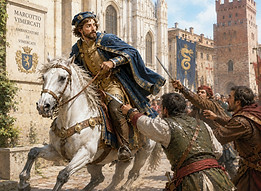
The Ambassador Who Escaped an Assassination Attempt
In 1402, the powerful Duke of Milan, Gian Galeazzo Visconti, died unexpectedly. His death plunged northern Italy into uncertainty as rival political factions competed for influence and control. The atmosphere was tense, and political missions could be as dangerous as military campaigns. During this period, Marcotto Vimercati was entrusted with a diplomatic mission to Milan. While carrying out his duties, he reportedly became the target of an assassination attempt by members of a rival Ghibelline faction. According to later accounts, armed men sought to intercept him before he could complete his mission. Fortunately for Marcotto, the plot failed. He escaped unharmed and survived the dangerous encounter, continuing his service during a time when political violence was an accepted tool of power. The incident illustrates the precarious position of medieval diplomats in fifteenth-century Italy, when a mission could easily become a life-threatening undertaking.
Why it is memorable: Marcotto Vimercati's story reads almost like a Renaissance thriller: political intrigue, rival factions, hidden enemies, and a narrow escape from death. It reminds us that for many noble families, survival depended not only on courage in battle but also on navigating the dangerous world of medieval politics.
William II of Württemberg (King) Ref 108

He Walked Around as "Mr. King"
One of the most famous anecdotes about King William II of Württemberg is that he regularly walked through Stuttgart with his dogs and without a large royal escort. Unlike many German rulers of his era, William preferred a remarkably informal relationship with his subjects. Citizens would often encounter him strolling through the city streets, parks, or public gardens, accompanied only by his dogs and perhaps a discreet attendant. Rather than addressing him with elaborate courtly titles, locals commonly greeted him as "Herr König" ("Mr. King"), a uniquely Württemberg expression that combined respect with familiarity. William was known to stop and exchange a few words with ordinary citizens, asking about their families, businesses, or daily affairs. Contemporary observers frequently remarked upon his approachable manner and lack of pretension. His dogs became almost as well known as the king himself, and many Stuttgart residents were accustomed to seeing the royal party wandering through the city without any obvious display of authority. The sight stood in sharp contrast to the heavily guarded and highly formal appearances of many other German monarchs.
Why it is memorable: The anecdote illustrates how different William was from many contemporary monarchs. Rather than emphasizing royal distance and ceremony, he cultivated familiarity and approachability. Few kings were remembered as fondly by their subjects as the ruler who could be encountered walking his dogs in the park and exchanging friendly greetings with passers-by.
Wrisberg (von) Ref 136

The German Baron Who Loved Dutch Tiles
In the eighteenth century, Baron Friedrich Moritz von Wrisberg (1716–1795) transformed Wrisbergholzen Castle into one of the most unusual noble residences in northern Germany. His family's fascination with ceramics went back decades. In 1735, his father, Baron Rudolf Johann von Wrisberg, had hoped to establish a pipe factory on the estate. Although that plan failed, the search revealed valuable clay deposits, leading instead to the creation of a faience manufactory that produced decorative ceramics and tiles. Friedrich Moritz embraced the family's passion for ceramics with remarkable enthusiasm. Rather than decorating his castle with tapestries or paintings, he created what became known as the Tile Room (Kachelzimmer). Its walls were covered with thousands of hand-painted Dutch-style faience tiles depicting scenes from classical mythology, ships, animals, rural life, and everyday activities. Visitors were astonished. Instead of entering a conventional aristocratic salon, they found themselves surrounded by what was essentially a giant illustrated storybook made of ceramic tiles.
Why it is memorable: Most noblemen collected paintings. Friedrich Moritz filled an entire room with tiles, and his family even operated the manufactory that helped make such a project possible. The Tile Room remains one of the most celebrated interiors of eighteenth-century Germany and is still closely associated with the von Wrisberg family today.

Gerry's Collection of Antique Seal Stamps.