


Queen Maria II of Portugal
and the House of Braganza-Saxe-Coburg and Gotha Dynasty


A Royal Seal Joins the Collection.
The recent addition of this seal attributed to Maria II of Portugal marks a significant enrichment of the collection, both from an artistic and historical perspective. This is not merely a functional object once used to authenticate documents, it is a carefully composed work that reflects the identity, legitimacy, and alliances of a reigning sovereign in the 19th century.
The seal presents a rectangular matrix in bloodstone, engraved with alliance arms beneath a royal crown and framed by vegetal motifs. The engraving is precise, balanced, and entirely in keeping with the conventions of royal heraldry of the period. Yet what distinguishes this piece is not only the matrix itself, but the extraordinary mounting that supports it. The gold setting, adorned with polychrome enamel garlands, rests upon a sculptural base formed by four allegorical children representing the seasons. Above, the faceted shaft in hardstone rises elegantly toward a richly ornamented pommel composed of a mosaic of hardstones.
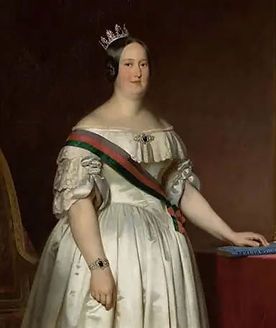
Queen maria II of Portugal

Arms of Portugal

King Consort Ferdinand II of Portugal


The small coat of arms of Saxony
Queen Maria II of Portugal.
Maria II of Portugal occupies a distinctive place in European royal history. Her life was marked by instability, restoration, and duty, reflecting the broader transformations of monarchy in the 19th century. She was born into a world where dynastic legitimacy was still paramount, yet increasingly challenged by constitutional movements and political upheaval.
Crowned as a child, deposed in her youth, and restored through civil conflict, Maria II’s reign unfolded against a background of tension between absolutism and liberal constitutionalism. Unlike many earlier monarchs, she did not rule in an era of unquestioned authority. Instead, she became a sovereign whose role was shaped by negotiation, compromise, and adaptation.
Her significance lies not in dramatic personal intervention, but in continuity. She provided stability at a moment when Portugal required it, and her reign helped anchor the transition toward constitutional monarchy. Through her marriage, she also introduced a new dynastic element into the Portuguese royal house, linking it to the House of Saxe-Coburg and Gotha, which would go on to play a prominent role across Europe.
Origins and Early Life.
Maria II was born in 1819, the daughter of Pedro IV of Portugal and Maria Leopoldina of Austria, and thus a member of the House of Braganza, the reigning royal house of Portugal since the 17th century. Her birth itself reflected the transatlantic nature of her father’s position, as he was simultaneously Emperor of Brazil and heir to the Portuguese throne.
Her early years were shaped by political complexity. In 1826, her father abdicated the Portuguese throne in her favour, establishing her as queen while she was still a child. However, this arrangement proved fragile. Her uncle, Miguel I of Portugal, rejected the constitutional framework and seized power, ruling as an absolutist monarch. As a result, Maria II spent much of her childhood in exile, particularly in France and England. This period of displacement was formative. She grew up not within the secure environment of a royal court, but amid uncertainty and political struggle. Her claim to the throne remained central to the conflict that would eventually become the Portuguese civil war.
The House of Braganza.
The Most Serene House of Braganza (Portuguese: Sereníssima Casa de Bragança), also known as the Brigantine dynasty (dinastia Brigantina), is a dynasty of emperors, kings, princes, and dukes of Portuguese origin which reigned in Europe and the Americas. The house was founded by Afonso I, 1st Duke of Braganza, illegitimate son of King John I of Portugal of the House of Aviz, and would eventually grow into one of the wealthiest and most powerful noble houses of Iberia during the Renaissance period.

The Braganzas came to rule the Kingdom of Portugal and the Algarves after successfully deposing the Philippine Dynasty in the Restoration War, resulting in the Duke of Braganza becoming King John IV of Portugal, in 1640. The Braganzas ruled Portugal and the Portuguese Empire from 1640 and with the creation of the United Kingdom of Portugal, Brazil and the Algarves, in 1815, and the subsequent independence of the Empire of Brazil, in 1822, the Braganzas came to rule as the monarchs of Brazil. The House of Braganza produced 15 Portuguese monarchs and all four Brazilian monarchs, numerous consorts to various European kingdoms, such as Catherine of Braganza (wife of Charles II of England who introduced tea to Britain) and Maria Isabel of Braganza (wife of Ferdinand VII of Spain who founded the El Prado Museum), as well as sometime candidates for the thrones of Poland and Greece, Infante Manuel, Count of Ourém and Pedro, Duke of Braganza, respectively, and numerous other notable figures in the histories of Europe and the Americas. The Braganzas were deposed from their thrones in Europe and the Americas at the turn of the 19th–20th centuries, when Emperor Pedro II was deposed in Brazil, in 1889, and when King Manuel II was deposed in Portugal, in 1910.
The Queen’s Reign.
Maria II was restored to the throne in 1834 following the Liberal Wars, in which her father successfully defeated Miguel I. Her reign, however, was not one of calm consolidation. Portugal remained politically divided, with ongoing tensions between different factions of liberalism and lingering conservative resistance. Governments were often unstable, and revolts were not uncommon. Within this context, Maria II’s role was primarily that of a constitutional monarch. She did not exercise absolute authority, but she retained influence through her position and her relationships with ministers. Her reign saw efforts to modernize administration, develop public education, and stabilize state institutions. While she did not dominate political life, her presence provided continuity. In a country emerging from civil war, that continuity was itself of considerable importance.
Her Two Marriages and Dynastic Alliances.
Maria II’s first marriage was to Auguste de Beauharnais in 1835. This union, however, was short-lived, as he died only months after the wedding.
Her second marriage, in 1836, to Ferdinand II of Portugal, had far greater dynastic and political significance. Ferdinand belonged to the House of Saxe-Coburg and Gotha, a German princely family that would become closely connected with several European thrones. This marriage marked the introduction of a new dynastic line into Portugal. Their descendants would form the House of Braganza-Saxe-Coburg and Gotha, blending Portuguese royal tradition with German princely heritage. The alliance is clearly reflected in the seal of the collection. The juxtaposition of the Portuguese arms with those of Saxe-Coburg and Gotha symbolizes not only a marital union, but a broader dynastic connection that would influence European monarchy throughout the 19th century.
Maria II’s life.
Maria II’s life was shaped by duty and endurance. She is often described as conscientious, serious, and devoted to her responsibilities. She was not a ruler inclined toward personal display or dramatic intervention, but rather one who fulfilled the expectations of her role within the limits imposed by constitutional governance. Her personal life was demanding. She bore eleven children, a fact that reflects both the dynastic expectations placed upon her and the physical burden she carried. Her marriage to Ferdinand II appears to have been stable and cooperative. Ferdinand, who had artistic interests and a cultivated outlook, played an active role in cultural life, particularly in architecture and the arts. Maria II’s achievements are best understood in institutional rather than personal terms. Her reign contributed to the consolidation of constitutional monarchy in Portugal, the development of administrative structures, and the gradual modernization of the state. Her death in 1853, following childbirth, was widely mourned. It reinforced the perception of a queen who had fulfilled her role at considerable personal cost.
The House of Saxe-Coburg and Gotha.
The House of Saxe-Coburg and Gotha occupies a central place in the dynastic history of 19th-century Europe. Originating as a German ducal house within the complex structure of the Holy Roman Empire and its successor states, it rose to prominence through a deliberate and effective strategy of dynastic marriages. By the mid-19th century, members of this house had established themselves on several European thrones. Perhaps the most widely known example is Albert of Saxe-Coburg and Gotha, husband of Queen Victoria of the United Kingdom. Through such alliances, the family extended its influence far beyond its relatively modest territorial origins.

The marriage of Ferdinand II to Maria II of Portugal must be seen within this broader pattern. It was not an isolated union, but part of a wider network of dynastic connections that linked royal houses across Europe. These alliances were not merely symbolic; they facilitated diplomatic relations, cultural exchange, and a degree of political cohesion among monarchies.
The heraldry of Saxe-Coburg and Gotha reflects this complexity. Its arms are typically composed of multiple quarterings, each representing inherited territories and titles. This layered heraldic structure contrasts with the more unified symbolism of the Portuguese arms, yet the combination of the two creates a meaningful synthesis. In Portugal, the introduction of this house did not displace the existing royal identity. Instead, it was integrated into it, producing a composite dynasty that retained the name and legitimacy of Braganza while incorporating the lineage of Saxe-Coburg and Gotha. This dual identity is precisely what is expressed in the alliance arms engraved on the seal.
The Coat of Arms Engraved on the Seal.
The matrix of the seal presents a classical example of marital heraldry, executed in a deliberately simplified manner suited to engraving.
On one side appears the coat of arms of Portugal, associated with the House of Braganza. The central arrangement of the five shields (quinas), each charged with smaller elements, is clearly visible even at reduced scale. The surrounding border of castles remains legible, preserving the essential identity of the Portuguese royal arms. Opposite this is a simplified representation of the arms of the House of Saxe-Coburg and Gotha. Rather than displaying the full and complex quarterings that characterize the complete dynastic achievement, the engraver has reduced the composition to its most recognizable elements. This was a practical and common approach in seal engraving, where clarity at small scale took precedence over heraldic completeness.

The two shields are placed side by side beneath a single royal crown, indicating both sovereignty and dynastic union. The surrounding branches - olive and oak - frame the composition and introduce a conventional symbolic contrast between peace and strength. This restrained treatment is not a loss of meaning but an adaptation. The engraver has preserved the identity of both houses while ensuring legibility and balance within a limited surface. The result is a composition that remains faithful to heraldic principles while being entirely suited to its function as a seal.
Descendants and the Present Day.
The union of Maria II and Ferdinand II produced a significant line of descendants. Their children continued the Portuguese royal line, and their lineage extended into other European royal families. Among their descendants were later kings of Portugal, including Carlos I of Portugal and Manuel II of Portugal. The monarchy itself came to an end in 1910, when Portugal became a republic. Nevertheless, the dynastic line did not disappear. Members of the House of Braganza, in its various branches, continue to exist today. The current head of the royal house is generally recognized as Duarte Pio, Duke of Braganza. Through broader dynastic connections, Maria II’s lineage is also linked to numerous European royal families. The influence of the House of Saxe-Coburg and Gotha, combined with that of Braganza, ensured that her descendants became part of a wide network of royal relations.
About the seal.
This seal stands as an object of both beauty and significance.
Its materials - bloodstone, gold, enamel, and hardstone mosaic - are of a high order. Its design is thoughtful and coherent. Its iconography reflects a precise moment in dynastic history, when the Portuguese royal house was joined with that of Saxe-Coburg and Gotha. Beyond its artistic qualities, it carries historical weight. It speaks of a queen whose life was marked by exile, restoration, duty, and continuity. It reflects the alliances that shaped 19th-century Europe, and the role of monarchy within a changing political landscape. For these reasons, it fully merits its place within the “Masterpiece” section of the collection. Not only for its aesthetic refinement, but also for the depth of history it embodies.

Henri I of Portugal (1512-1580)

Isabelle of Portugal (1503-1539)

The arms of Emmanuel I of Portugal
Gerry's Collection of Antique Seal Stamps.