

The Boyle Family
Rise and Legacy of an Anglo-Irish Aristocratic House


A Dynasty Built on Ambition and Influence.
Few families illustrate the transformation of early modern Ireland more vividly than the Boyles. Their ascent was not the product of ancient lineage but of exceptional determination, political skill, and strategic accumulation of land. From the moment Richard Boyle arrived in Munster in the late sixteenth century, the foundations were laid for a dynasty that would shape Irish political life, influence English affairs, and extend its legacy through numerous aristocratic lines.
With estates at Youghal, Lismore, and Dungarvan, and branches spreading across the peerage - from the Earls of Orrery and Burlington to the Viscounts Shannon - the Boyle family came to embody the Anglo-Irish elite at its most dynamic. Their history intertwines colonial expansion, economic enterprise, patronage of the arts and sciences, and a distinctive heraldic identity.

Richard Boyle, 1st Earl of Cork (1566-1643)

The coat of arms of the Boyle family

Charles Boyle, Earl of Orrery

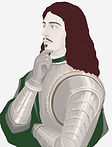
Robert Boyle

Henry Boyle, Earl of Shannon
Early Origins and the Rise of Richard Boyle, First Earl of Cork.
The story of the Boyle family begins not with long-established nobility but with Richard Boyle himself, born in Canterbury in 1566. Trained in law, he travelled to Munster during a period of upheaval marked by confiscations following the Desmond rebellions. He had the foresight to acquire large tracts of forfeited land, including the properties of Sir Walter Raleigh, among them the town of Youghal and the great fortress of Lismore. These purchases, combined with his careful management of tenancies, markets, and port revenues, allowed Boyle to build both wealth and influence at a remarkable pace. As Munster recovered from war, he positioned himself as a central figure in its reconstruction. His loyalty to the Crown during turbulent periods, especially the Nine Years’ War, earned him royal favour. James I recognised his growing stature by creating him Baron Boyle of Youghal in 1616 and Earl of Cork in 1620. His rise was a testament to how economic initiative, legal acumen, and political reliability could form the cornerstone of a noble house in early modern Ireland.
Richard Boyle Was Known as “The Great Earl”.
The epithet “The Great Earl” attached itself to Richard Boyle during his lifetime, reflecting the extraordinary scope of his achievements. He accumulated vast estates across Munster and developed them with an energy that impressed both friends and rivals. He improved the towns under his control, secured economic privileges, and built or repaired numerous fortifications. His influence reached far beyond his own lands, for he became a central figure in Irish administration, notably as Lord Treasurer. Equally significant was his dynastic strategy: he arranged advantageous marriages for his children, binding the Boyle family to prominent English and Irish houses and extending its reach into many spheres of public life. His legacy was not simply one of wealth or office but of enduring institutional influence. Through his policies, patronage, and the prominence attained by his descendants, Richard Boyle set the pattern for an aristocratic dynasty that would remain influential for centuries.
Family Branches and Aristocratic Connections.
From Richard Boyle’s many children emerged an intricate network of aristocratic branches. Roger Boyle, one of his younger sons, became the Earl of Orrery, a title associated with military command, statesmanship, and literary activity during the Restoration. Through another line arose the Viscounts Shannon, whose political dominance in the eighteenth century, particularly through Henry Boyle, Speaker of the Irish House of Commons, made them indispensable to the governance of Ireland. The Burlington branch, originating from the Boyle earls of Burlington, added an important English dimension to the family’s heritage; it was through this line that the Boyles became linked to the illustrious Cavendish dynasty. Other branches, such as the Carleton and Dungarvan lines, further extended the family’s reach, each acquiring titles, properties, or reputations of their own. In this way, the Boyle name became interwoven with the fabric of aristocratic Britain and Ireland, producing soldiers, architects, statesmen, thinkers, and patrons across successive generations.
The Boyle arms.
The heraldic identity of the Boyle family is centered on the striking shield blazoned Per bend embattled argent and gules. This simple division, a diagonal line rendered in battlements, symbolises fortitude and defence. The silver portion suggests integrity and constancy, while the red evokes martial courage and authority. Unlike ancient noble families whose arms evolved over centuries, the Boyle arms reflect the self-conscious construction of a new aristocratic identity. They speak to Richard Boyle’s world: a frontier province recovering from rebellion, fortified houses rising across Munster, and a new Protestant order consolidating its authority. The embattled line itself seems emblematic of the frontier conditions in which Boyle proved his worth, while the clarity of the design gave his descendants a symbol easily recognizable and suitable for augmentation through alliances.

As the Boyle family diversified, each major branch adapted the original arms to reflect its own heritage or circumstances. The Carleton branch introduced a crescent into the field, a traditional mark of cadency indicating descent from a younger son or a cadet line, yet also serving as a distinguishing emblem for a house connected to new properties and titles. Elsewhere, the Shannon line added a bird, often depicted as a martlet, symbolising continuity or aspiration and suggesting a line that had taken on new responsibilities or honours. The Burlington line, which merged with the Cavendish family, incorporated a central escutcheon bearing additional quarterings, thus reflecting the accumulation of English estates and dignities. Heraldry in the Boyle dynasty thus functioned as a visual record of its expanding influence: each variation carried with it a story of marriage, inheritance, ambition, or service.
Boyle Estates, Properties, and Economic Power.
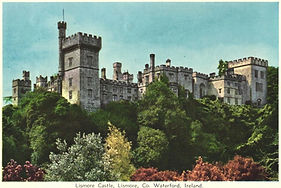
The Boyle family’s ascent rested on the solidity of its estates. Lismore Castle became the jewel of the family’s Irish holdings, its medieval structure reshaped into a formidable residence. The town of Youghal served as a commercial hub, where Boyle invested heavily in port facilities, housing, fisheries, and trade. From these centres radiated a network of properties - Dungarvan, Tallow, and numerous smaller estates - each contributing rents, agricultural income, or industrial profits. The Boyles were not merely landowners but entrepreneurs: they operated ironworks, timber yards, and shipping ventures, and they encouraged English settlers, artisans, and merchants to establish themselves in Munster. As the family grew, some branches extended into English estates through marriage, bringing with them the architectural and cultural refinement associated with their Burlington and Orrery kin. These properties provided the material basis for the family’s long-standing political influence in both Ireland and Britain.
An Anecdote from the Boyle Legacy.
Among the many stories attached to the family, one of the most frequently recounted concerns Robert Boyle, the celebrated natural philosopher. His experiments with air pressure - later formalised as Boyle’s Law - were conducted in Oxford with apparatus transported from Ireland. According to a popular anecdote, when his crates were inspected at the docks, a customs official remarked that “even the Earl of Cork’s air must be taxed.” The tale, although humorous, reflects the reputation the Boyles had acquired: a family whose reach extended from Irish estates to English universities, whose wealth was visible in every corner of their activity, and whose aspirations moved far beyond the traditional concerns of landed gentry.
Important Figures in the Boyle Family.
Over the centuries, various members of the Boyle dynasty distinguished themselves in politics, science, literature, and war. Richard Boyle’s children occupied many significant posts, while his son Robert attained lasting renown as one of the founding figures of modern experimental science. Roger Boyle, Earl of Orrery, combined military leadership with literary accomplishment, becoming an influential voice in Restoration politics. In the eighteenth century, Henry Boyle, later Earl of Shannon, dominated Irish parliamentary life, exerting a degree of authority that made him one of the most powerful political figures of his age. The Burlington branch, through Richard Boyle, 3rd Earl of Burlington, connected the family to the flowering of English Palladian architecture and drew the Boyles into the cultural orbit of London’s elite. Each generation produced individuals who shaped public life, contributed to intellectual or artistic movements, or played significant roles in the administration of Ireland and Britain.
Monuments to the Boyle Legacy.
Richard Boyle took deliberate steps to preserve the memory and status of his dynasty through monumental sculpture. In the Collegiate Church of St Mary, Youghal, he erected an elaborate funerary monument celebrating himself, his two wives, his mother, and his children - a striking composition typical of early seventeenth-century aristocratic self-presentation. Crafted in alabaster and black marble, it portrays Boyle in a recumbent pose with figures of his family arranged around him, affirming his role as the founder of a renewed noble line in Munster. An even grander monument was later installed in St Patrick’s Cathedral, Dublin, commemorating members of the wider Boyle dynasty. Larger in scale and more ambitious in design, it reflects the family’s prominent place in Irish public life during the seventeenth century. Together, these monuments stand as enduring markers of the family’s wealth, piety, and political influence, and they remain among the most notable examples of Anglo-Irish funerary art of the period.
Gerry's Collection of Antique Seal Stamps.